Photo credit: Josh Gooden
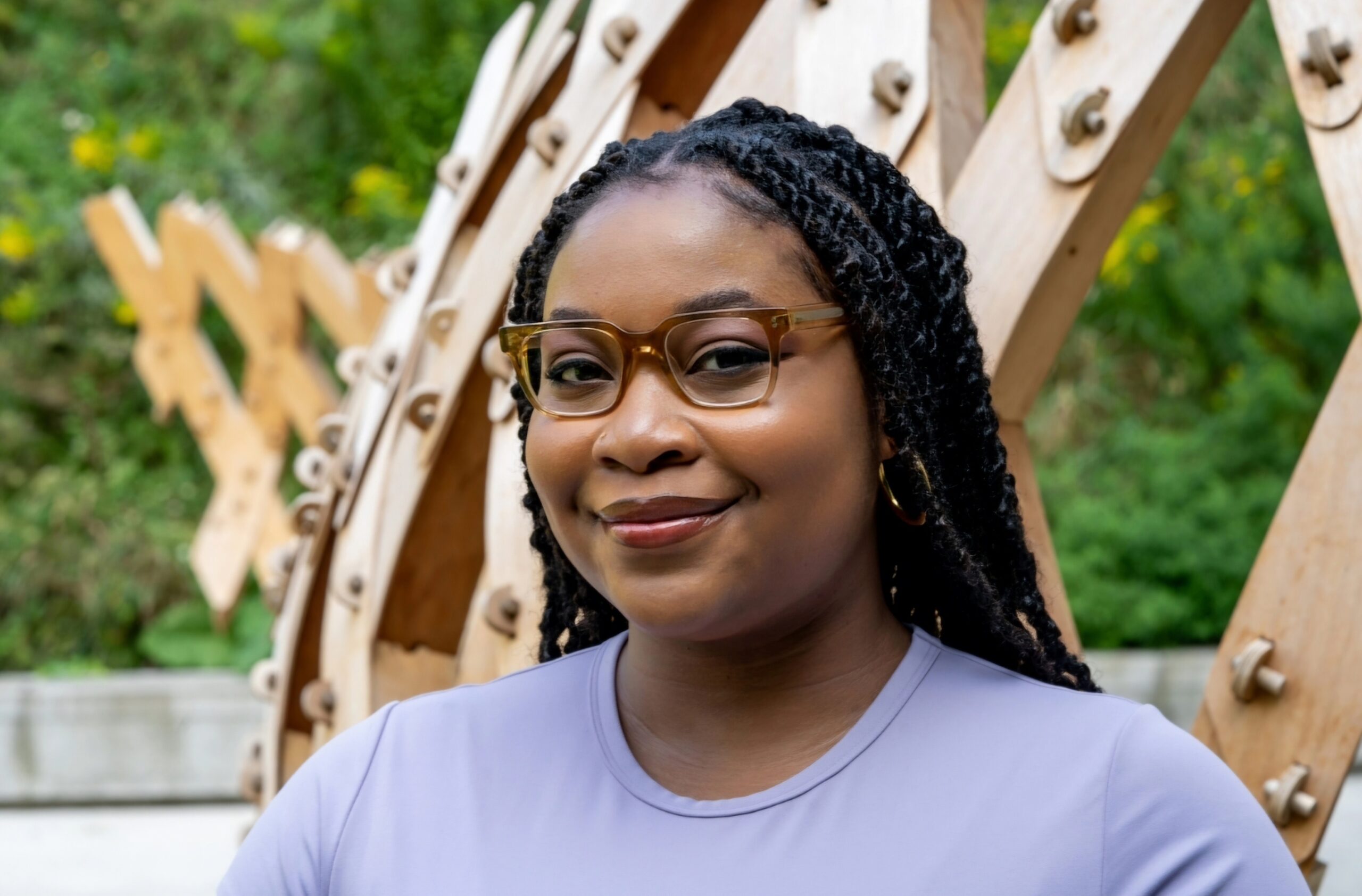
Terese Mason Pierre (she/her) uses speculative fiction to imagine new worlds, constantly questioning the notion of reality and fantasy. Her debut poetry collection, Myth from House of Anansi Press (2025), is a lyrical ode to the complexities that come with honouring various truths, histories, and legacies.
She is the editor of As The Earth Dreams (2025): a collection that has brought together Black Canadian writers in a series of short stories imagining a future void of current systems, envisioning a new form of joy and resistance. The collection has been nominated for the Ignyte Award, Locus Award, and Aurora Award. Pierre lives and works in Toronto, where she is an editor at Augur Magazine and the co-Director of AugurCon.
In our excitement to have her as our judge for the 2026 Fiction Contest, ROOM’s intern, Selin Berktas, had the chance to chat with her about writing in community, speculating futurity, and who gets to determine fact and fiction. Writers can submit to this year’s contest through September 15th.
ROOM: The first thought that comes to mind when I think about your writing is the discomfort of very different and seemingly contradicting worlds. This shows up in your debut novel Myth in its various realms, as well as in the collection you edited, As The Earth Dreams, through examinations of the opposite ends of binaries—life and death, past and future, isolation and community. This is the notion of speculative fiction, I suppose: reflecting and rewriting through experimentation of supposed opposites. Does this influence your work as an editor?
TERESE MASON PIERRE: Yeah, as an editor, I am first and foremost interested in walking alongside the writer as we are both exploring their work or the work that needs to be edited. I had an experience like this quite recently. I’ve been an editor with Augur specifically for almost 10 years. 2018 is when I started. I have been building my editorial philosophy and practice. I mostly edit poetry, but sometimes fiction. Something that I really hold true is that I’m really focused on making sure that the words on the page, every single word, is a choice.
I understand from a poetry perspective that sometimes, you know, lines just sound really great, like the vibe is there, and you’re like, yeah, that sounds good, I’m gonna put that in. But as an editor, even though I understand that we were vibing, let’s go back here. Why these words? Or why? Why are these words in this order? I want to make sure that the author feels confident in their work, and part of that confidence, I think, comes from deliberacy and precision in language. To communicate what you want to be communicated, because the reader is going to take whatever they want from your work, right? You just have to make sure that what you want to say is there.
I try to hold the ideas of what I want to do as an editor, versus the choices that authors make. Most of the time, they’re aligned, and sometimes they’re not. What I keep in mind always is that this is the author’s work. My ultimate goal is for them to be happy with what they’ve put out while my more specific goal is that they are intentional with what they’re putting out, and we leave no stones unturned. So that is still in accordance with my overall goal. Even though at times we can be saying different things or wanting different things in the micro.
It’s more accessible to me to think about discomfort from a writing perspective, or a thematic perspective, which is why it probably shows up a lot in my writing. I tell everyone, now that I turned 30 last year, that I’m different. I’m a different person. One part of that transformation has been accepting challenges, with open arms, Oh, this is an opportunity. As opposed to being like, I’m anxious and I don’t know how to deal with this. Feeling anxious is fine, but this thing is not going away. One of those things has been having deeper conversations with writers around the ways in which my vision for the way I want to edit their work, and the vision that they have for their work. Those visions might not always be aligned because we are in different positions—I’m the editor and they are the writer. I have more work to do in terms of going to them, like meeting them where they are at, rather than risking making them feel like I don’t hear them or that I don’t understand them, which is not what I want.
When I was working on As the Earth’s Dreams, I didn’t run into many challenges. All of the writers were quite amenable to my suggestions and had excellent suggestions of their own, but most of them are also people that I know, that I’m friends or acquaintances with, which is not always the case when I work with authors at the magazine. There was already a degree of familiarity and already a degree of trust.
ROOM: Including a story from our managing editor, Chimedum Ohaegbu.
TMP: Chimie’s great! Oh, I love her story.
ROOM: You recently wrote an essay for Locus about our relationship with poetry, the demands we make of poetry while allowing more flexibility in fiction. While your debut poetry collection book was written over a few years, Myth and As the Earth Dreams were published only six months apart last year. What have you learned, reflected on, or navigated in the process of working on two publications that are vastly different in format and creative process, but similar in speculative content? How do these mediums present different angles of literary experimentation?
TMP: I feel like these questions are like a story. You start the question and I’m like where will they go with this? Every new sentence is a sentence I did not expect.
So the first thing I learned is: don’t publish two things in one year. But that’s not really up to me. I feel like As the Earth Dreams could have come out earlier, but there were a lot of delays on my part, so that’s my responsibility. With Myth, the poems were written between 2019 and 2022. I was in a much different place then. I’m thinking about that time in my life. Covid notwithstanding, that was a time when I was not very good at telling people how I felt, so I would hold a lot of like, anger, or like, whatever the emotion was—I would just hold it inside me. I would assume that if I were to share, I would not be heard. I took all of that energy and I put it into poems. I call my speakers jaded and yearning. I feel like yearning, fundamentally, is a discomfort, so there was a lot of tightness and a lot of stuckness, but also more room to speculate.
Because if you’re sitting in a space where you don’t feel like you can live the life you want to live, or have the relationships you want to have, or like the world around you isn’t what you expected, I feel like it’s very easy to turn to the speculative in terms of imagining something new or different. Regardless of whether or not you feel empowered to go and then make those changes in your life. So a lot of my poems in Myth are about people yearning for love or lamenting at how their city has changed, or their environment has changed, or how they wish they knew more about their history, certain events that happened that they wish that didn’t happen, or just dreaming, a lot of dreaming. That’s the place where Myth came from.
In the months leading up to the publication, I felt like, Oh, I’m gonna feel really anxious about what people think about my work. I thought I would feel more anxious about that but because the book also came out when I was deep in my MFA thesis. I was like, I gotta focus on writing my book. The feelings of pride and satisfaction were delayed.
Sometimes I’ll go back and reread. I don’t even remember writing some of these poems, which is fascinating. I can’t necessarily access the headspace of who I was when I was writing these poems.
A lot of what I speak of now is in retrospect, from what I know about myself and my work and the narratives I built around the book. That’s also been informed by reviews. I was told a lot that I write about grief. Like, I did not know that until it showed up in a review. That was interesting to learn. When it comes to As the Earth Dreams, I was much looser. I knew that I wanted to bring in Black writers, I wanted it to be speculative, but it was very difficult for me to narrow down or center a theme per se, at least in the beginning. I wanted Black writers to write whatever they want, I’m already allowing for a multiplicity of ideas and a multiplicity of perspectives and forms. I really truly just wanted people to write whatever they wanted, and I think that diversity shows up in the stories. I didn’t really feel like I should restrict the writers in terms of what they were interested in and what they were excited about.
ROOM: The introduction to As the Earth Dreams states, “When it comes to literature by marginalized writers, we can ask: Who defines speculative? What narratives and writings are considered mythology? What is considered realism? Which people—and which legacies and institutions of power—get to discriminate between the real world and the unreal?” Can you speak a little about this — about who, in which bodies, are allowed to determine the real and unreal — and how it impacts your writing and editing philosophies?
TMP: I started thinking about this when we did a conference called AugurCon—this is in 2020—the first AugurCon I did. There was a keynote panel with Larissa Lai, Jael Richardson, and Joshua Whitehead. I was the moderator for this panel. I can’t believe that happened, but one of the things that Joshua Whitehead had said really stuck with me, was that, living in or underneath a settler-colonial state, the idea of what is considered “real” or “true,” versus “fantasy” and “false” is, a lot of the time colonially determined.
Lots of things that are very essential to people’s cultures, aspects that are true, important and sacred, will just be written off as just fantasy or made up by settler-colonial logic and its brand of empiricism. That really got me thinking about that binary, or maybe it’s not even a binary—it’s a spectrum. Even the fact that I think it’s a binary might be influenced by the West’s approach to nature and knowledge and exploitation. This idea that we have to go out in nature and dissect it and carve it up. That we need a specific kind of evidence, that things aren’t real until a white man sees it.
I’m willing for my work to be interpreted however people feel. Part of that comes with writing in community. I don’t think I need to be an expert on my work. I think part of bringing my work to a community means that there might be people in the communities around me who might know more about what I am writing about than I do. I don’t really want to lay claim to anything outside of what I feel about my writing—which is mine—but the writing itself can exist, will exist in other people’s minds however they want.
When it comes to editing, I think a lot about language specifically. I was editing two short stories by someone who had used a type of patois that I had not encountered. I don’t think they were drawing necessarily from a specific language, because the work was also speculative, but I remember having conversations with my fellow editors on how to edit the piece and how to remain respectful. Part of being engaged in speculative literary spaces is that I don’t think you’re going to find a lot of restrictions there or a lot of really firm boundaries. A lot of things are fluid.
ROOM: I’m going to follow up on that because you were talking about speculative spaces. You’re not only an editor at Augur, but you also facilitate programming, workshops and communal writing, so what does speculative arts programming look like, and how does it push the boundaries of traditional literary education?
TMP: When it comes to creative writing, I think people will have a lot of opinions. At some point it becomes really exhausting. In speculative literature spaces, in workshops, in my experience both attending and facilitating—it’s less pedantic or didactic, less about these are the rules of literature. For every person who’s talking about the hero’s journey and how conflict is central, you’re gonna find someone else talking about a non-traditional structure, or a passive and non-agential protagonist, slice of life. I think people are much more open. The content of people’s writing is speculative, so their work isn’t necessarily bound to the rules of common reality.
I think the ways in which people write will also similarly not be bound to strict or specific techniques on how to write a story while living in the West. It’s different for publishing — publishing is a business and they have their own rules that you need to follow in order to make money. When it comes to writing and like letting people explore what they’re interested in and what they’re passionate about, I’ve found much more encouragement and support for people who want to try new things.
ROOM: Who are some writers you return to when you need an embrace?
TMP: An embrace? That’s so funny. I don’t really reread work. It’s mostly poets. I go to poetry when I want to feel inspired, but also when I want to slow down. I’m interested in writing that is concrete in some way, too—we can have all these big feelings, but then also an ant moving along a kitchen tile.
ROOM: Numerous media outlets have listed you as an emerging writer to look out for. What’s next for you and what are you hoping to focus on in the coming year?
TMP: I’m always being watched. I kind of do feel a bit of pressure. This is also easily ignorable. I’ll do whatever I want, and you can just watch me. I just got accepted to library school, so I’m doing that next year. I’ve been very slowly working on this novel since 2022. It is also about grief. Unfortunately, I cannot escape the allegations. I haven’t been writing poetry in a very long time. I wrote a poem recently for my friend for his birthday, and that felt a little rusty.
ROOM: So we’re so excited that you agreed to judge Room’s 2026 fiction contest. Thank you so much. Do you have any advice for first time contest submitters? How should people express what pulls at them the way you perhaps do?
TMP: I have a very poet answer, which is that I’m interested in the truth. Earlier in my editing practice, I got very frustrated with writing that seemed like it was trying to hide something from me. I know something’s here, just tell me the truth. I would say I’m interested in what feels true to the writer or what feels true to the characters, which may or may not be the same thing.
It’s not that I expect vulnerability necessarily. I don’t think you necessarily need to be vulnerable. I don’t think truth and vulnerability are necessarily the same, but they can be similar. I hope that in writing fiction, folks feel like they have been challenged just a little bit, because the truth often challenges you. For first time contest submitters: your whole life does not depend on this. What’s most important to me is that people feel proud of what they’ve submitted. That they would do it all over again if they could. That there’s a healthy separation between work and worth.
ROOM: In numerous interviews and conversations, you’ve talked about the role of imagination as resistance. Can you give us an example of something you either wrote or read that felt simultaneously imaginative and like an act of resistance?
TMP: As I’m getting older—I like saying that—I’m only turning 31. Nothing I have read or written recently—I am still slow to return to this, unfortunately. But, as I age, I’m interested in being very purposeful, in developing and cultivating the types of friendships and relationships that I want. I have this instinct that it’s better to do things on your own or it’s better to isolate yourself because people won’t understand you or people have other things going on.
But, in the idealized version of my life that I imagine, that’s not the truth. That’s not the case. I’m constantly fighting against the systems that, in very insidious ways, try to keep me tired and alone. I do this by thinking about ways in which I can be a bit more honest and with the people in my life who love me and who I love. I feel like that’s a bit of fighting back: whenever I choose to reach out, whenever I choose to ask for help, or even ask questions and be curious about other people’s lives, I am resisting.