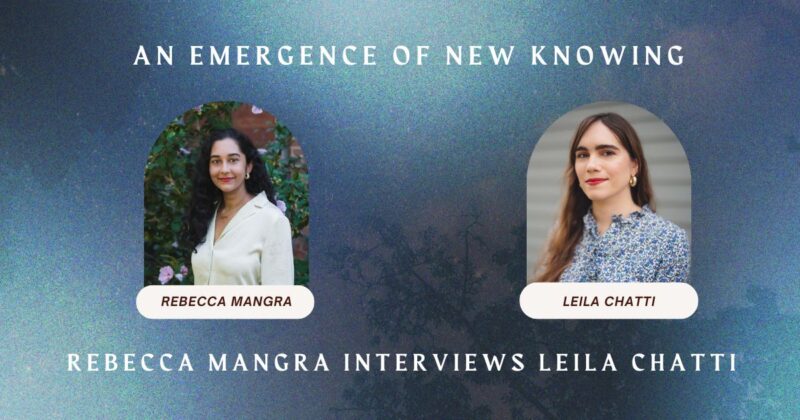
Photo of Leila Chatti by Marcus Jackson. Photo of Rebecca Mangra by Brittany Carmichael.
Named one of Electric Literature’s Best Poetry Collections of 2025, Leila Chatti’s poetry collection Wildness Before Something Sublime deftly navigates the imbrications of despair and wonder with haunting grace. Writer and editor Rebecca Mangra interviews Leila Chatti to chat about her collection, inner mythologies, moments of recognition, “What would Anne Carson do?”, and her inspirations.
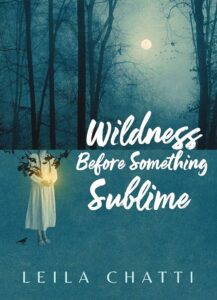
Rebecca: I wanted to start by talking about the cover. It’s very Gothic-inspired! We have the moon, thin trees, and what seems to be a headless woman holding a flame. But she also has leaves on her shoulders and birds near her feet. There’s an immediate tension that reflects the title. We can recognize this solemn figure as human, but she’s also much more. That’s where the sublime comes in.
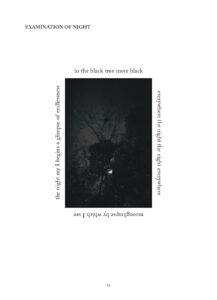
You return to this idea of image and text in your poem “Examination of Night.” You have these photos of night seen from windows and they’re dead centre on the page. For me, they felt like portals; I was leaning into them. You also have words framing them. It reminded me of Diana Khoi Nguyen’s work—using archives and photographs to try to find the language that is in conversation with the images. What was it like compiling these photographs of nature at night and finding the right words to be in conversation with these very mysterious, portal-like images?
Leila: I love how rich that question is! It’s a meaty question. When I was writing “Examination of Night,” I was thinking about and circling around these obsessions (this is a very obsessive book). I was spending a lot of time writing these poems at night, and much of that writing would happen by looking out at things around me and trying to write about them. In our usual narratives or mythologies around night, we describe it as a place of absence or the lesser version of the day world. We think, Oh, when night comes, it’s as if the world is obliterated, but when the day comes, we’re all present again and the beauty is able to be there. But I think for me, I was interested in how much beauty there was in the night and the ways you have to really pay attention in order to encounter it. Because of my experiences, some of them being illness, I would be up at night at odd hours, and I would look out into the dark and find a lot. I was able to adjust my gaze to see these subtle differentiations in the kinds of darkness I was seeing, looking out the windows and really making sense of the night scene. For these images, I wanted to capture some of that looking and the ways I would literally look out a window, and just stare into the night to see what I could see in it. So, I wanted to capture that feeling of looking, but also the kind of looking and knowing you’re unable to be reaching the end or beginning of something because there are limitations of sight or attention or awareness of being exhausted. It was close, yet I knew I would not be able to capture everything. The night is so close and hyperpresent, yet it is something impossible to nail down, and I think that slipperiness revealed a lot to me about other things like myself, sense of self, identity, dream self, and the unconscious self. Those things that I could see glimpses of and kind of describe, but it was difficult to capture the whole thing. It almost felt kaleidoscopic, trying to talk about some of these things. I wanted to keep turning them, and every time I did, it would be a new ordering of those ideas. It would become something different because of that disruption. I wanted the photos to feel like where you enter is where you enter and you can choose to leave where you leave. In my existence in the night there was nowhere to be, so I can look as long as I want, but I’m entering and leaving at a time of no event or chronology. It felt outside of time.
I’d go into art galleries and see these paintings of night and remember being interested in how difficult it would be to paint night. You can see glimpses of the shores and the trees, but from a distance, it looks murky: this sort of greenish-black colour. I really loved those. The difficulty in capturing an image was something I was trying to do with those poems [“Examination of Night”]. Similarly with the cover, night has these connotations of absence, lack, the bad shadow world to what is seen as good, and I think winter is that way too. Winter is seen as the opposite of brightness, warmth, and these ideas we have about summer or spring. I was living in places with a lot of winter, and I was definitely experiencing it in a negative sense, but to survive it I had to see what was good and beautiful about it. I went on this quest to like winter and really live winter. I think I’ve come around! I used to hate winter with every fiber of my being, but now I really appreciate the potentials in winter, just as there are potentials in night, even if I didn’t seek out wanting to be awake at night or living in winter. If I could have chosen, I would have preferred being in day or in warmth, the kind of things that are seen as good, but instead I was seeing what was and seeing that there were things to be loved.
R: Where did you grow up? I’m assuming it was somewhere without winters?
L: No, I grew up in Michigan! [laughs] I think because of that I hated winter. It would be this time that descended on the state. I did split my time all my life between Michigan and Tunisia. In Tunisia, we’d be there in the summer—it’s beautiful, warm. There are things that I very much valued like flowers, swimming, and tons of sun. I thrived. But when I came home to Michigan for the rest of the school year, it was cold and dark for a lot of it. I really closed down. I do struggle with SAD [seasonal affective disorder], so the depressions I would sink into that were seasonally linked… I really dreaded it. So, I tried to move away from winter as much as possible. I graduated early from college in order to leave Michigan and moved to California. I tried to stay in sunny and warm places. I went to graduate school in North Carolina. But in the period of writing this book, I was primarily in Wisconsin, which I did not enjoy. I was also in Massachusetts, which I loved, but it also got quite dark and cold. It was there that the final bits of this book came together and that’s where I learned to really love winter. I literally lived on Winter Street, so I think the world was trying to tell me something!
R: As someone who grew up in Toronto and continues to live there, I can confirm that being a Canadian is a lifelong journey of learning to love winter. I loved winter as a kid because I have all these pictures of building snowmen and wearing snowpants. But as an adult, you do feel that tension when it gets dark outside at 5 p.m. and feel like your life is over. What I really saw in this collection was in investigation in winter and trying to, as you say, sort of corral this expansiveness, which is impossible to entirely capture.
L: They’re magical times, both winter and night. They have their challenges, but they’re underappreciated as being a time of magic, or magical thinking or magical being.
R: I also wanted to talk about colour in this collection, which you mentioned briefly before. I found colour to be an interesting and recurring motif throughout. In “Equinox,” you write, “My future holds no promise of green”, and in “Invisible World,” you write, “Lilac / willing to be beautiful.” Was colour a north star for you in the collection?
L: I would say yes. I think it was easy to think of night as black and white, but I also didn’t want that. There is a lot of baggage in that—there are a lot of cultural associations of what that means. I’m thinking primarily of race. I didn’t want to position, at all, black as night as something bad, or white as day and sun and something good. It was something not of interest to me and I felt in writing about night, I wanted to break some of those associations of darkness as bad, or brightness as good. I was careful when black and white would appear.
I was interested in colour because I would try to describe the night and other things, like mountains. I was in Taos for three months and I kept off social media and the internet at that time, so I was looking a lot. Colours I had been told that [described] the world were not always matching up with what I was actually seeing. It also felt true about night and winter. When I was a kid colouring with crayons, I was told that the mountain is supposed to look grey, but when I looked at it, I saw purple and lavender from a distance. I started to become interested in these subtle colours inside of the objects we take for granted or overlook, and also the mythology of certain colours and what they hold.
I was in therapy during a lot of this and one of the exercises I did was to create my own idea of what colours meant for me. I had done this illustration with symbols, and my therapist had me identify colours and what they meant. There are traditional scripts of what we culturally think of as being affiliated with various colours, but it was a rewriting of my own associations of [for example] when I see green, what does green mean for me? When I see purple, what does purple mean for me? Those two colours, in particular, I zeroed in on during this time. Lilac and green became two colours that meant for me creativity and fertility—I felt that they were linked, and so they became very present in the book, which is interested in those themes. Those colours were floating in my mind, and I love having objects in my space that [literally] do that. My office is green. My other office, prior to moving to this home, was purple. I have all my notebooks stacked; they’re all lilac. There’s a commitment to my own inner mythology of what I think colour can be and mean.
R: This idea of colour and inner mythology is something we all subscribe to. I’m also a lilac person! I have these lilac gel pens that I always use. We all have our devotion to certain colours and what they mean to us.
L: I’m interested in symbols and how we make our own. I think we inherit a lot. That’s of interest to me: the subconscious and where we have cultural subconscious. I’m also interested in our own individual narratives that we transpose onto symbols. The book circles around image and colour because I’m trying to figure out what my symbols are and what they represent to me.
R: The collection is so much about these moments of recognition. Isabella Hammad talks a lot about the idea in her Between the Covers podcast episode. I made a lot of notes! I feel like I’m always looking for them now in books. The collection, as you say, is also doing that. Recognitions of the artist and the self, the pain of chronic illness, efforts to conceive a child, all of these tangible sites of pain. But then that information becomes public domain when we publish our books. This private pain becomes public. Sometimes, your speakers feel very hopeless, but they’re also trying to find something through that despair and grasp something. In “While Living,” you write, “Amazing, / my ordinary weaknesses. / How infinite. How ordinary to / survive them, to be in the plain / evening / speaking of it.” That was a great moment of recognition where one realizes that there’s this theatre in our mind and we do have to spit these players out and look at them. How do these moments of recognition play with the shadow work in the collection?
L: I think they are the shadow work. I wrote the vast majority of this book not thinking I was writing and not willing or wanting to look inward. The places of encountering what was true and not always fun to see—I was so uncomfortable with that looking that I literally did not look. I was writing these poems on my phone and the next night, I would swipe so fast (inevitably when I was doing the same thing) that I wouldn’t see what I had written [the night before]. There was a period of about five years between writing a lot of the book and me actually looking at what I’d said. Since I was writing so many of these poems on the brink of sleep, I really didn’t remember them. There was this great liminal space prior to sleep where I would be my most truthful self because it felt like I didn’t have the same reflexes to put up the boundary. My truth serum is that you have to make me tired! A part of me understood this subconsciously, and that’s why I didn’t want to look at [the poems] the next day. It allowed for me to break through these real blocks that I was putting up in my conscious life and work. The book is the lifting of the veil to see me in real time encountering what I felt and thought, and how I made sense of what felt senseless at the time. I wanted to preserve those real encounters.
Those sections—“Divine” and “Night Poems”—are pretty much preserved the way they came out. I wanted to do it that way because I felt it was important to preserve the realness of thought and encounter. This is how this new knowing emerged in me. It’s not something I tinkered with or tried to convince someone of something. I didn’t do any censoring. It was very important to document what it felt like to be really afraid of what might come out if I were to put it down and then also kind of wade in without knowing where I was going. I remember distinctly that writing during those years felt like walking forward in darkness with a flashlight where I could see what was right in front of me, but couldn’t know what was behind me. Writing the poems felt like [taking] one step, seeing it, and it’s gone. That’s the way I learned how to move on the page and through encounters of self—there was a lot of new self-making in that time that needed to happen, but it was very uncomfortable.
R: Speaking of multiple selves, I wanted to ask about how your work has been received online. The first time I read “Tea” was actually on Tumblr. It had thousands of notes! Your work appears a lot on the platform with people like Sylvia Plath and Anne Sexton, all of these people who you’re writing to in the first section of the collection. I’m wondering what it is like to know that you have these poems resonating with contemporary audiences?
L: Wow! That’s wild to me (having been a Tumblr girl in my youth). I think it’s the greatest honour. I came to poetry before I even knew it was a business. As a kid, I loved poetry from day one. I was someone who did not come to it through any sense of what poetry was to an external world. I truly delighted in writing poems at like four or five years old. I liked the sound, the smallness. I loved repetition. There were a lot of elements in poetry that really appealed to me as a young person. My initial love of poetry was pure. The first writers I encountered were poets like Plath and Sexton, and it was the first time I felt like I was reading something that felt as if someone was looking into my own mind. And that felt good! That kind of knowing. So, they were my guiding stars. Plath, in particular. When I was really struggling in this period in the book, I was invited to read at Smith College. I was so overwhelmed that when I first walked off the plane and saw Matt Donovan, who runs the center there, with his little sign that read “Leila Chatti,” I burst into tears. I was emotionally overwhelmed. He was horrified because he thought he made me cry! He’s great.
I was really having a moment of crisis and trying to figure out what poetry meant to me. Did I want to stay in academia? I was in a job I was really unhappy in. I was really trying to figure out what was next. How do I navigate as a writer? Do I want to keep doing this? I remember walking across the street to go to Smith College where I was going to meet high school students for a contest I’d judged, as well as college students, and talk to them about their poems and do a reading. I was really struck by this clarity of… My God, this is my life. I get to just be here. Poetry brought me here and this is what I wanted. I was grappling about whether I wanted to be a professor or not, which is a different question. I was equating professor with writer because I think so often in our world of academia, those two things become intertwined as a way of survival. But I realized I never had this dream of being a professor when I was younger, but I really wanted to be a writer because I wanted to be able to connect with other people, the way that writers like Plath connected to me when I felt very alone. So, to be on Smith campus, where she went to school and walking into the buildings where she had been…I ended up looking into the archives the next day and I saw her typewriter…and just to know that I would be going to speak with these young girls, some who were sixteen, was a reminder about what it was actually about. This can’t be taken from me by anyone because it’s the love of writing. Already, I had done what I wanted to do, which was to write poems and have someone else see themselves in them or be engaged in them. That was so clarifying. After that moment was when this book kind of unlocked for me, where I was able to start looking at those old poems and start feeling a little braver as a writer in a way that I had been scared to as an academic.
It’s a great privilege to be read. Our lives are lonely and getting lonelier, even as we’re hyperconnected. Maybe that’s part of the loneliness because often, we’re not really connected. But to know that despite our vast differences and vast distances, there are people who are able to see things that felt so lonely in the time that I was living them and be able to say, me too, or I value this—that’s deeply healing to child me, adult me, and all the selves I’ve had. I feel a great responsibility then. For me, when I’m thinking about work already written, I always ask myself, could this be of use to anyone else? And if it is, then that’s one of the hurdles to get passed in order for me to send this out. If I think, no, it will not help anyone or do harm, I don’t want to send it out. I don’t want to be taking up space just to get attention. I want what I make to be useful. I try to decenter myself as much as possible even though I’m very present in the poems. I’m not going to even try to be coy, I’m definitely the “I” in my poems! But by the time I write them, it’s less about me and it’s gone when it’s done writing; it no longer belongs to me. I’m reading Alice Notley right now and she has this line… let me find it for you…
“A poem is something you can have
you read it and you have it. […]
In 2017, everything at the
same time because the furthest-down body is loose
I know when you act, surrounded by the at-
tention that makes you exist and which when you
go you won’t take with you. I live where no one
from your world is and what if I’m making what you
can have—even when you go? because it
knows the air, inscribed on it or spoken in-
to it the real body’s texture how spring comes.”
[“Archival Quality I Remember” by Alice Notley]
I love that sense of home is something you can have. Once it’s done, it’s yours. It’s not really mine. And that feels like the reason to share. A lot of the external validation from authorities— that’s not really of interest to me. When I’m reading, I’m looking to see and be seen. I hope that’s what the work does and I’m honoured if it happens. The greatest form of intimacy is to be known.
I’m looking right now at a post-it note above my desk that I’ve had for years that reads: WWACD? It stands for “What would Anne Carson do?” I very much love Anne Carson for her work, but also as a creative artist. She certainly gives me permission to do whatever I want. Her interest makes me interested. I think my interest might make others interested. Whatever interests you is interesting! I think owning that instead of feeling ashamed of our particularities or our quirks and our weird ways of being and thinking—those can be strengths. I’m not the first person to think of these things or work this way, but maybe if someone encounters my work and that allows them to write in ways that are a little wilder for them, then that would be great. We move as a culture now under a state of constant fear—there’s a lot of reasons for that. There’s a lot of judgement and a lot of scrutiny in our hyper-online and interconnected lives. I think that is scaring some of us, especially younger writers, for making mistakes or taking risks creatively. It makes me sad because the most fun I have is when I don’t know what the hell I’m doing and kind of blundering my way through. The new making requires some confusion or bewilderment that doesn’t always work very well in the public view, but are good for the self and for art. I would hope that if anyone’s nervous to be weird that they’d be more comfortable in being weird.
R: What a great way to end things off. Be weird!
L: My question for my students is an inherited one from Jane Hirshfield’s list of revision questions: Is it strange enough? What is strange is usually what’s true or more true. What’s familiar to us is usually something inherited or what we’ve been told. Allowing yourself to be strange is a good thing—that’s the highest compliment I can give my students. Weird excites me!
Purchase Leila Chatti’s Wildness Before Something Sublime through Open Books or the Bookshop for Gaza bookstore, also run through Open Books.
Leila Chatti and Rebecca Mangra wish to highlight and urge readers to support the following fundraisers: Mutual Aid for Lebanon and Amal for Palestine.