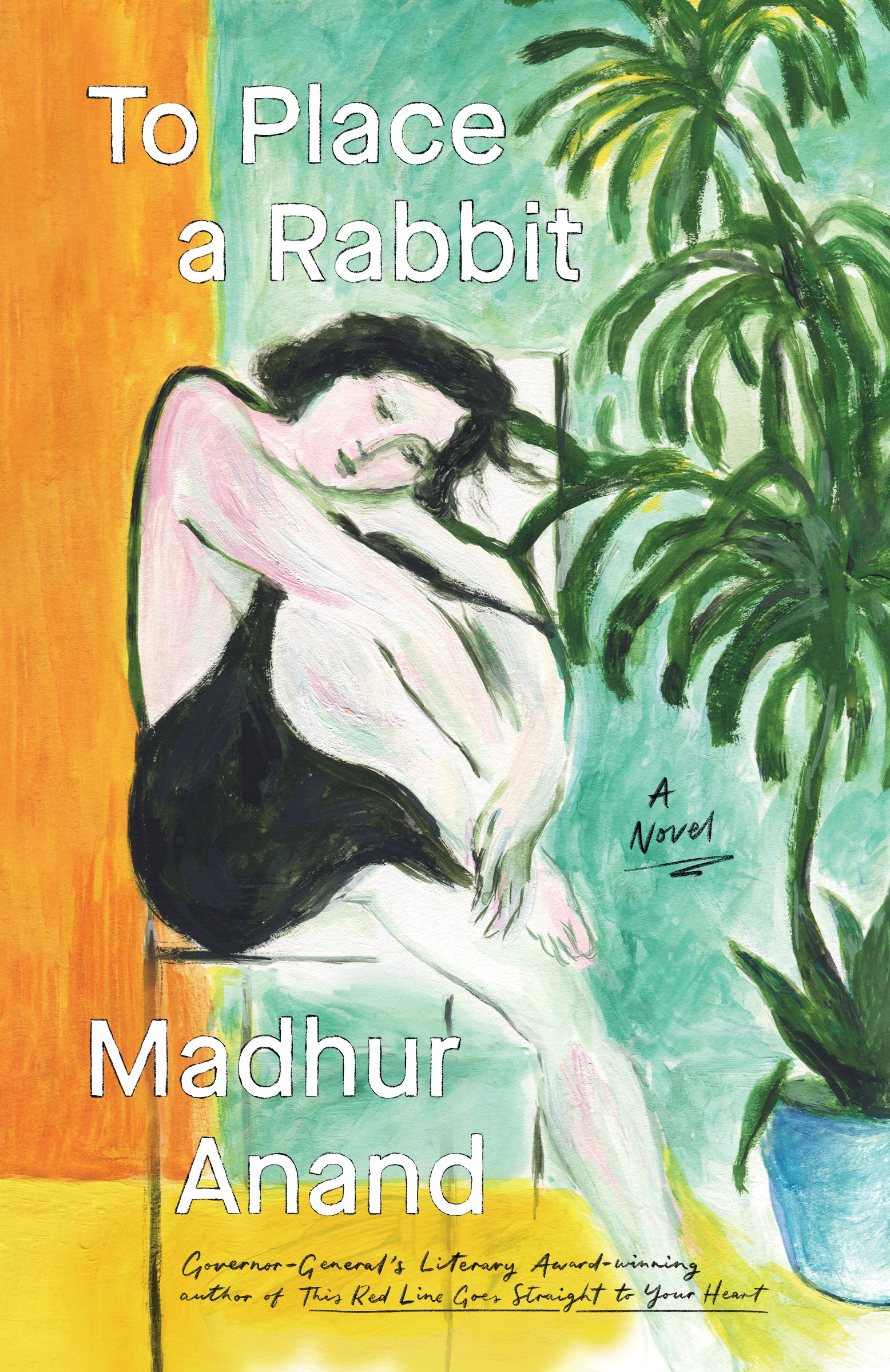
To Place a Rabbit
by Madhur Anand
Knopf Canada
240 pages
$33
The phrase “to place a rabbit”—poser un lapin—translates as “to commit to doing something but not show up for it.” Doubling as the title of Madhur Anand’s debut novel, the expression at once captures the predicament of the novel’s protagonist and Anand’s inquiry into literature and the act of writing; of the ways in which personal life and scientific rationality may enter the process without ever truly dominating it.
The novel centres on an unnamed protagonist, a writer and a scientist, who volunteers to translate a novella for an author who has only ever had her work published as a French translation, but never in its original English. Each chapter is broken into three sections: an account of the present; a fragment of the fictional novella the protagonist is working on translating from French; and a recollection of the protagonist’s turbulent relationship with her French lover.
Anand blurs the boundary between reality and fiction by incorporating artifacts à la W.G. Sebald or André Breton, such as photographs, diagrams, and an elusive “blue folder.” This fictional object acts as a repository of hauntings, collecting the protagonist’s incomplete projects, books, printed texts, tasks, and memories—things the protagonist keeps meaning to reengage with, but cannot seem to find a way back to. Anand even appends her own version of the “blue folder” at the end of the novel, which collects the various literary works mentioned in the novel.
To Place a Rabbit is guided by a constant questioning of the creative process, whether it be original writing or translation. The protagonist challenges the firm separation between the two until, at the very end of the novel, she makes her most definitive proclamation: “I knew that all copying was translation, just as all writing was fiction.” Yet she also admits to being a bad translator, explaining that she “could not help but skip sections, entire exchanges of dialogue, episodes, because I found they did not speak to me . . . I knew there was something unscientific, and even unethical, about this.”
Fittingly, Anand structures her novel as a faux academic journal article, opening with an abstract and ending with a conclusion. This stylistic feature sheds much light on the “translated” sections of each chapter, which become a kind of living document; an experiment in blurring literature and reality. The result is a work that resists easy categorization. Perhaps it would be unfair to call To Place a Rabbit simply a novel, for doing so overlooks the fact that the uncertainty and inner tension of Anand’s protagonist exist within any reader who deems themselves a writer.