In a world where it’s possible to augment remembering and memory-making, where does that leave our relationships?
Today, we’re sitting with “Surviving in Captivity” by Premee Mohamed, from our current issue Room 49.2 Science.
Surviving in Captivity
by Premee Mohamed
“At night the sick sleep in a dormitory in the sanctuary, hoping to be visited by the god in a dream.”
-—Robert Garland
All the seedlings are dead.
Sean laughs, a little strangled sound, which she knows is shock—her body reflexively responding to the unexpected. Has she accidentally walked into the wrong lab? Is it an optical illusion caused by the sun on the growth chambers? If so, then she will laugh again in a moment, out of relief.
Her watch beeps discreetly, an old-tymey valet courteously reminding the young master that there are proper heart rates and improper ones… the noise breaks her stasis and she breathes again, but there is no relief.
She’s well aware she should put on her sterilized coveralls, glove up, sanitize the gloves, and get on a mask. A single exhale in this moist atmosphere might contaminate the tiny, fragile plants and cause mould that will smother and kill them—but if they’re already dead then it doesn’t fucking matter anyway. She has to know.
Bare-handed, bare-faced, she shoves her bag and scarf out of the way and wrenches open the closest cabinet, seizing the first box on the shelf. When she left the lab on Friday night, this one, like the others, contained a delicate greenish-white marbled thread stretching from the surface of the clear growth medium to half an inch above it, with a scattering of finer, silkier threads below. Now it looks empty.
Sean thinks again: I have to know. Even though the plastic is transparent, she forces the lid up with her thumb, distantly aware that the alarms are going off at her workstation—each box has a monitor sticker, like the kind you put on babies, set to alert if the temperature, humidity, or gas levels leave normal parameters. She has not deactivated the program. She doesn’t care. There is no smell of death inside the container, no rot or mould. But the seedling is absolutely dead: brown and collapsed, no hint of green.
She is still trying to accept this when the door opens an hour later and her grad student Walker comes in, a big shaggy boy with long hair and a sweat-smelling backpack. Because of the placement of her workstation, Sean is able to watch Walker’s face change as he sees the empty tissue culture boxes—first startled, then horrified, then seeking out reassurance and normality.
“Walker,” she calls out.
He shambles over in his enormous overengineered sneakers, and before they can even begin to discuss damage control they pause in wonderment, for both their watches are beeping, warning them about their hearts.
“What happened?” he says, then before she can say that she doesn’t know, he says, “What are we going to tell Dr. B?”
“We have all the weekend data,” she says with a confidence she doesn’t feel. “This place has more surveillance than a max-security prison, okay? You know that. We’ll find exactly what happened and when, and then we’ll explain it to Yakub when he comes in.”
He nods nervously, and Sean feels the urge to snap at him—not him exactly, not Walker the individual, but what he represents. These students are delivered to her on a regular basis, and rotate through the lab for eight months on work experience placements, one of those corporate social responsibility things. They often have what she thinks of as dog names, like Spencer and Parker and Cooper (there have even been a few Lunas and Bellas); they are interchangeable to her, bright ambitious kids good at jumping through extremely neurotypical interview hoops and fitting in with the ‘culture’ here. They are not useless but she never feels she knows how to use them properly. They always give her very high ratings when they leave.
And they know they are temporary, they have no roots here, so they in a very real sense have nothing to lose if a project goes wrong. But Sean has been here for six years. This is her whole life. “This is my whole life,” she says, accepting that Walker will give her a strange look for saying this, and he does. She says it again. He nods again.
***
It’s fully dark by the time Sean boards the train—not home, but to Whitemud Heights, her sister’s care home. In the silverblack plastic of the window Sean’s face is puffy and wan, featureless except for the two pink smears behind her glasses. She is angry at herself for crying in front of her supervisor and her student; she is angry that she had to leave, too. It had felt like leaving a patient mid-surgery to die on the table, even though she knows she is being dramatic. Feelings are not supposed to come into her research.
The Heights is brightly lit, a friendly beacon of carefully-calibrated spectra designed to support optimal mental health. The dozen one-up one-down triplexes are guarded by dense evergreens, genetically engineered to live much closer together than wild trees and to emit a damp and soothing perfume that cuts through the smoke blanketing the city.
At the sign-in desk, her sister’s caretaker Persyus emerges from a side door, holding something out to Sean: a small cardboard box festooned with courier stickers (FRAGILE, DO NOT BEND, CLEARED BY CUSTOMS). Sean takes it, noting the lightness. “Oh,” she says. “I was wondering where it ended up… I didn’t realize I put here as the delivery address. I meant to have it delivered to my place.”
“Are you all right?” Persyus says.
“I don’t know.”
The caretaker’s eyes are black and very sharp, like the eyepiece of a microscope—darkness looking into light, seeing invisible things. They say, “Lilion hasn’t eaten yet, and I don’t think you have either. I’ll get you a dining room token.”
“Thanks.”
In Lil’s room, Sean ungimmicks the cardboard box and sets up the tablet using its built-in stand, then searches the wall for a charging pad hidden among the posters, photographs, paintings, and prints. There have to be at least four per room, for personal devices and for the surveillance cameras—there, just under a framed piece of Lego art. Sean lifts the frame and sticks on the tablet’s magnetic charger just as Lil comes in.
“We’re getting food delivered!” Lil says. “Is it a holiday? A birthday? Not mine, don’t say mine.”
“Persyus just felt sorry for me,” Sean says. “I thought we could eat in the dining room?”
Lil drops her head, a gesture of mild distaste rather than shame or anger. “I asked for delivery. I don’t really like eating with the others.”
“I… well, okay. Anyway, I got you something. New gadget.”
Lil regards it with the understandable wariness of a cat watching its owner remove a pill from the packet. As Sean is about to explain, the door opens and one of the caretakers—not someone Sean remembers—brings in the two trays, sets them on the desk, then shuts the door again without a word.
“Delivery!” Lil says. “Is it a holiday? A birthday? Not mine, don’t say mine.”
Sean uncovers the trays. “Chicken alfredo,” she says.
“Awesome!”
They eat at the desk. The new tablet shows a little smiley face on a black background as it powers up—yellow now, headed to green. A century ago—Sean did a paper on it in undergrad—a condition began to be diagnosed called dementia praecox, in which symptoms of senility appeared in adolescence. In the sixties, the diagnoses vanished, renamed as schizophrenia, with its own different and distinct set of diagnostic criteria.
Then about twenty years ago, there was another, baffling outbreak of what really did look like childhood senility—tremors, intermittent amnesia, loss of short-term memory, balance issues, aggression, elopement, personality changes—and it was treated as a kind of dementia until the real cause was finally uncovered and named: Haslam-Xi syndrome, caused by a novel virus transmitted in utero via mosquito bites. Sean, born before the outbreak, escaped it; Lil, conceived four years later, was simply in the wrong place at the wrong time. As with most of the other HX patients her symptoms had begun to appear around eleven years old.
Sean still struggles to remind herself that she cannot speak to Lil as a child or as a senior; her sister is an adult. But she has lived here for a very long time. There’s no cure; Lil is on a couple of medications to manage symptoms (an anxiolytic, a tremor-reducer, essential oil supplements). For everything else there are the gadgets Sean keeps bringing in, because she cannot think of what else to do for a twenty-eight year old living in a care home, and doing nothing is utterly inconceivable.
“What does this one do?” Lil says as they eat, pointing her chin at the tablet.
“Nothing if you don’t use it,” Sean says, and they both laugh. Part of the reason (she will not admit this to anyone, even Lil) that she visits so diligently—twice a week, come rain or shine—is that she wants to be the one person Lil does not forget. And this is not scientific. This is hope. It does not even always work—there have been periods of weeks, sometimes months, when Lil does forget. But Sean comes anyway, doggedly, believing.
They were both ordinary-looking children; now Sean is still ordinary-looking and Lil has grown into kind of a weird extravagant asymmetrical beauty, like a rare orchid. She does not resemble a flower; she looks like something that evolved to fool something else to survive.
“You’re not wearing your ring,” Sean says lightly. “Grandma’s ring.”
Lil gives a little start, and goes to the jewelry box on her dresser, returning with a small silver ring set with a red stone. Sean feels little guilt about the subterfuge; along with the ring (not Grandma’s at all, but a tracker device bought two years ago) there are Lil’s glasses—prescription, she does need them, and the video feed can also be tapped into by Sean and her caregivers—and Lil’s smartwatch, which she never remembers to wear. Sean has sometimes thought (and this thought span data-contrast=”auto”>does come with guilt) that she would chip Lil like a dog if she could, so that there would be a way to watch her all the time, but the ring is the best she can do in terms of trying to keep her sister safe without telling her. And Lil claims to be quite used to the cameras.
“It’s green,” Lil says, and Sean turns her attention gratefully to the tablet.
“So this was actually developed by the Haslam-Xi Association of Canada,” Sean says, pressing the button on the side. The tablet wakes up, showing a simple black-and-white grid with a plus sign in the centre of each square. “It’s called a Relate, presumably because all the good names were taken.”
Lil giggles, but her expression remains cautious, and she makes no move to touch the screen.
Sean says, “See, you can add people from your support group if they have a Relate too. It syncs automatically and it’s meant to be super easy to use. So like, anyone you like, you can just add them. And then you can talk to them with one click.”
“Oh,” Lil says.
There’s a long pause. Sean finds herself torn between pointing out, correctly, that Lil does not have to use it if she doesn’t want to, and, also correctly, that you can at least try something before deciding that you hate it. She says, instead, “Well, you’ve been going to the support meetings for like five years, right? Who do you like talking to the most? We can see if they have one of these things and add them.”
Lil shakes her head. “I don’t really like any of them.”
“Nobody? Really? What about—”
“No, I don’t want to talk to any of them,” Lil says, her hand trembling noticeably. A noodle flies off her fork and lands on the rug. “You’re the only person who’s remotely interesting to talk to. The rest of them are like…”
And she waves her fork again, and this time Sean understands this to mean: Like this. Like this lovely, thoughtfully-designed care home with its rounded corners and its unobtrusive cameras, its excellent staff-to-resident ratio, its game nights and fun little contests and visiting storytellers, drag queens, therapy dogs, stage magicians. Sean is interesting because she is outside of this system—she works, as it happens, for one of the five enormous pharmaceutical companies whose philanthropy funds the home, but she is still outside. She comes from outside, with the smell of wildness on her, outside air.
Sean chews on the inside of her cheek to forestall tears again, and says, “Well, if you think of anybody, you can just add them later. How’s that?”
“Sure,” Lil says. “I guess so.”
***
Sean hasn’t been laid off, but she isn’t really employed either, Yakub explains the next morning when she beeps in, slightly late. She is in a kind of liminal space—at his words, Sean thinks of how she felt last night, doors slamming on her one after one, till she is left in a kind of antechamber, somewhere between in and out, a place meant to be transitory. You are meant to pause there and then go through a door, not stay there. They have to get rid of the dead seedlings before they do start to get mouldy and contaminate everything else, so it’s all hands on deck: her, Yakub, and Walker.
“It isn’t even,” Sean points out, gesturing at the three of them, “a huge project. We’re almost an accounting error. They could just let us keep the funding.” She shakes the tissue culture gel out of the box and into the bright orange drum marked INCINERATION (3B), then passes the empty box to Walker, who puts it in an autoclave bag.
“No decisions will be made about your position right away. You’ve been working on the project for five years,” Yakub says, and she knows he means it to be reassuring, not an indictment of five years without progress. Five years is nothing in primary research. In grad school she worked on a tissue culture project for field peas that had been running without significant progress for eleven years. They weren’t waiting for a breakthrough, only incremental improvements in survival rates, and they were funded every year, and she reminds Yakub of this.
“I know,” he says gently, passing her another box. “But that was at the university.”
“So? Tissue is tissue. Can’t we just tell the committee that we—”
“This is a corporation, Sean. We made the biggest possible mistake here,” he says. “We overpromised and underdelivered.”
“Overpromised? We didn’t promise anything. We didn’t even say we knew all the compounds that were found in the petals. We said possibly a hundred and forty times in the proposal. Jesus Christ.”
“We promised we could make more,” Yakub says, and that much is true. Sean winces. The False Queen-of-the-Night orchid (Orchis boweri) is nearly extirpated in the wild, and after the big environmental reforms of the past twenty years, its remaining wetland habitat is not protected. Every year what little remains burns and burns again and sometimes burns quietly all winter, under insufficient snow. They are not wet any more. They are just land. When Yakub’s team collected the specimens for this batch of tissue culture five years ago, they had looked for a long, long time.
“They’re meeting on Thursday—for appearance’s sake,” Yakub says. “The funding itself will be cancelled.”
“You know that?” Sean says, more in surprise than in contrariness. She does not mean to be combative, and Yakub once again gives her grace. He passes her another box and she pops open the lid—she’s getting very fast at this now—and simply flicks the gel into the drum with a snap of her wrist.
“In the Slack,” he says, meaning the channel of managers, PIs, and supervisors that Sean and Walker do not have access to. “We might be able to find you something in another department. There aren’t a lot of openings right now. But there’s the Obesity Initiative—”
“They’re all assholes. I’d rather scrub floors.”
“Well… and there’s Plastics. I think they’re looking for a tech for the fire powder project, but… it would be a downgrade for you. And a significant pay cut. Same with carbon capture.”
“Carbon capture is bullshit,” she says patiently. “It’s been bullshit since day one. It’s never, ever worked at any scale past garage band. How come span data-contrast=”auto”>they keep getting funded? They never produce results.”
“Because their funding comes from the government, and it comes from the government because it’s a captured regulator,” Yakub says. “I know. It’s not fair. But there we go.” He straightens up and rubs his back.
He is Ethiopian, and somewhere in his vigorous mid-sixties, Sean knows, yet he seems much older than that—he has not only gone grey but white, and his coppery skin has faded like a book left out in the sun. She is not sure if that is related to age or something else. He emanates an aura, in management meetings, of absolutely straight-faced Wise Old Mystic From A Movie; but at the same time, she knows he is the best possible supervisor she could have during something like this. He will fight for her if not for the project. It is really only her attachment to it that is keeping her from moving on, like him, into this kind of zen-like detachment where she serves only science, not any particular aspect of it.
But she is not Yakub, and she says, “What about our genome? That’s not nothing.”
“A genome isn’t a plant,” he says. “To them, it is nothing. It has no utility.”
“What about our cryo-holdings?”
“We’d need funding for retrieval, and that wasn’t in the budget this year. It would be next year before we could request it.”
“What about—” Sean begins and stops, staring at the box she’s holding. Was that a glimmer of green inside the milky white gel? After a few seconds she realizes it’s just a reflection of one of her earrings, and is startled and wounded by her own hope. She cannot think of what this reminds her of, and then thinks, Of course, Lil. Sean is working two jobs really—this one and her sister, after their mother happily moved overseas earlier in the year—and the jobs are bleeding into one another. Or feeding off one another. She is not sure. The routines, planners, notes, schedules, e-ink displays, keycodes, everything meant to keep Lil from wandering off and her mind from descending into an eternal darkness, and nothing works for long… they have tried nearly a hundred protocols to get these seedlings to grow along with their fungal symbiotes, and they thought it was working, and now this.
Sean flings the entire box into the drum, and Yakub and Walker look away. After a moment, Yakub hands Sean another box and she takes the lid off and removes the gel again, calmly.
Yakub says, “You have some time off accrued, don’t you?”
“I don’t know.”
“You could take some time,” he says. “You don’t need to be here to watch the axe fall. None of us do. It doesn’t change the decision. It would be healthier for you to be elsewhere and rest.”
Where would I go? she almost says, but her PI isn’t here to answer questions like that. The work just needs to get done and then she’ll think about it. The deaths cannot be allowed to contaminate anything else. The entire structure, from ceiling to floor, is set up with sterilizing protocols to prevent such things, but you still have to make sure. Death spreads. It doesn’t stay where you put it. It’s like life.
At lunch Sean stares at the picture taped to the wall behind her computer, the same one she gave Lil: a close-up of the tiny purple-and-white blossom of the orchid, smaller than a lentil. The False Queen-of-the-Night is not parasitic but para-parasitic—like many others it can survive on its own, but it needs its particular fungus to thrive, using it as a delivery service to access nutrients, water, and minerals from the wet soil of its home.
The fungus, too, came back with them on that long-ago field excursion. Sean was no fool; she knew the orchid would never grow on its own. It needed its friend. And they were doing all right, they were. The seeds germinated; the roots went down into the gel, the fungus thrived. Then nothing. The data did not show a single blip in any parameter, not for the entire weekend. Why, why? If she’s taken off the project she’ll never know. It’s all so short-sighted, it’s… it’s the decisions of people who think a single quarter ahead, not a decade ahead. What will she do? Jobhunt again. Dear God. She has to update her CV, her list of publications, call her references…
She drums her fingers on the counter near her laptop. “Walker?”
“Yeah?”
“It’s Tuesday, right?”
“Uh, yeah. Are you all right?”
She looks up, staring into the lens of the small camera in the corner of the room: the opening like a tiny, glassy beetle, slightly elongated for better field of view. “Like a goat,” she says.
“Pardon?”
“Or an antelope. Do you have any meetings tomorrow?”
“I can check.”
“Good,” she says. “Good. Yeah. Check.”
***
“Turn your phone off,” she tells Walker as the door of the underground parkade begins to rumble open.
“But I need it to—”
“You don’t need it for shit. I’m the one driving,” she tells him, and hands him her phone. The steel door creaks to the top, opening to nothingness—a rectangle of darkness with no lights at all, as if they are about to drive into the void. “Turn that off too. Thanks.”
He takes it, and the screen lights his face for just a moment—alarmed but awed, as if he is in the presence not of a saint but something divine and malevolent, and above all unpredictable—before he turns it off and the car is as dark as the world outside.
She urges the car up the ramp, heart pounding. Her watch is also off, stored in her pocket. At least Walker was not present for her earlier act of subterfuge—digging into the undercarriage for the transponder and carefully not removing it (it’s set to alarm if the connection is broken) but covering it in a few layers of the copper-infused tape they use in the growth room, which will garble its signal into nothingness every time it pings the location grid. Useful things always have more than one use. First lesson of science. Like Walker here: he is protection and labour, but he is also here for morale, so that Sean has someone to retain the last of her sanity for.
If they have forgotten anything in the lab, too bad. It’s about three and a half hours to the last confirmed sighting of the False Queen-of-the-Night, just west of Desmarais, and they need to be back today. If the car is gone overnight, there will be consequences; but the automated system will not flag a car removed and returned on the same day.
“But we never figured out what was wrong with the growth chambers,” Walker says now, nervous. “What if the same thing happens?”
“I’ll explain later,” she says. “Let me concentrate, okay? I haven’t driven for a while.”
“I can drive if you want!”
“No, just make sure I stay awake. And don’t distract me.”
***
The sun is up by the time they reach the last of the road, and the air smells strangely clean when they get out—it is not, it is only that the smoke is thinner here, the everpresent smoke of spring, and it is a little more humid. Sean considers this a good sign, but she will still not allow herself to feel hope. Walker unfolds himself from the passenger seat. “Should I get the cooler?”
“Yeah, let’s unload.” She watches him curiously as they unload the trunk of the completely (she has to admit) inappropriate car—a ridiculous two-door Twitch she would never have accepted in her fieldwork days. “You don’t seem terribly worried about committing career suicide with me?” she prompts him.
“I don’t think that’s what’s going to happen,” Walker says, putting the bright blue cooler on the ground.
“Which part?”
“The death part,” he says. “Not the with you part. I just think, you know—I mean, what you said, I don’t think it’s wrong. And I think if this works, we’ll get our funding back, and if it doesn’t work, they’ll just…” He shrugs. “Well, what can they do? Take the nothing away?”
“It’s not the project. It’s your future. You’ve still got something to lose. Me, I’m kind of burning every last bridge doing this.”
“I don’t know,” Walker says slowly. “I mean, yeah. Misappropriation of company assets, and, uh… and I guess that includes me… I just, if we were back at school, boy, this would be a lot, right? But Qubelectic is just so… so huge. I always feel like we don’t matter, because we’re so tiny in the grand scheme of things, I mean we’re both just two little dots in an org chart of a zillion people… and sometimes I guess, hey, it sucks to not matter, and sometimes it’s cool to not matter.”
“… How old are you, Walker?”
“Um, twenty-one. I started university a little early because—”
“Grab the cooler. I’ve got the bags here. Come on.”
Sean leads as they walk down the remnants of the gravel road and into what remains of the peatlands, now golden and brittle. Burned snags protrude like blades, sharpened to points from repeated fires.
“Is this where you got the samples from last time?” Walker says.
“No, it was about an hour north of here. But that whole area is a no-go now—it just burned in February. I thought here might still have some moisture.” She looks around as she walks; there is not enough treeshadow to obscure her view, and that causes her a strange pain. “This looks a lot like the original site though. Or more like looking at its ghost… I don’t know. Maybe there won’t be anything out here. And it’s pretty early in the year. It won’t be flowering.”
“I didn’t think of that.”
“No, you’re biochemistry,” she says without rancour. “It’s okay. I know what to look for. I have a theory… I’ll tell you when we get there.”
***
There takes several hours of walking. Slowly the blackened blades of dead trees turn to the weedy, determined seedlings of birch and aspen and larch, which she mostly disregards. Those are tough trees, drought trees; they don’t indicate the kind of water she’s looking for. Shrubs begin to reappear, then skinny saplings. She pauses and touches the soft needles of evergreens: Not you, not you.
“I keep looking at my watch,” Walker says, chuckling.
“Me too. Bad habit.”
Sean pauses and closes her eyes, sniffing the air as if it might help, and to her surprise, it does: there is a smell of something nearby. Not water necessarily but rot, and there is no rot without water out here. There is only desiccation, which loses its smell at once. “This way, I think.”
At last there is shade, green and bright still, trees still leafing out or evergreens too young to tower over them. The ground finally begins to sing out underfoot and she tells Walker about how Tudor farming manuals used to tell farmers to listen for the ground rather than touch it when it came to seeding time: it has to speak, because if it’s dry it will be silent.
“Can I help look?” Walker says after an hour of silence after the farming discussion.
“Not unless you can recognize the microhabitat we’re looking for,” she says. “Sorry. Or I guess I shouldn’t assume. How’s your species ID?”
“Um, nonexistent. But if you told me what to look for—”
“A lot of the forbs out here look the same,” she says apologetically.
“Forbs?”
“Oh boy. No, come on.”
“Do you think we’re close?”
“Don’t jinx it.”
***
She doesn’t turn anything back on until they are nearly back at the lab, and then nearly drops her phone: 17 missed calls, 15 text messages, 10 voice messages. She stares at the list, not looking at the caller IDs just yet, her exultation evaporating: Has their little excursion really been so bad? There is still daylight; surely Yakub of all people cannot be so upset; is it Security, Corporate Asset Management, something like that?
No. Almost all are from the Whitemud Heights security desk; some are from Persyus, increasingly frantic. The caretaker’s most recent text reads: I’m getting a lot of bouncebacks—PLEASE call me.
“What happened?” Walker says, reaching out to steady her, then drawing his hand back—they are both covered in dirt and sweat, and Sean’s light blue jacket is already filthy. Behind them someone honks, and Walker adds meekly, “Maybe we should pull over.”
She does, somehow, and they block the mouth of an alleyway, illegally, while Sean stares at her phone again. “I don’t know. Something happened to Lil. They called and called—oh my God. They must have thought I was dead or something.”
It takes her a long time to realize that in the silence around them there is another silence, and eventually she realizes that Walker is holding his hand out in front of her. She stares at him uncomprehendingly, her ears ringing with shock.
“Can you unlock the doors,” Walker says, then, as if embarrassed at his tone, adds, “please. Let me drive.”
“But I—” No, she wants to say instinctively, without even thinking. I did this, this was my idea, that means that this is my fault. All of it.
“Come on, I’m your assistant. Let me assist, okay? It’s like you said.”
“What’s like I said?” she repeats, dazed.
“Your theory,” he says. “While we were digging. You told me.”
She doesn’t remember. Slowly she gets out of the car, and they switch sides.
***
The sun is nearly down by the time they reach the Heights, fighting the tail end of rush hour with the other commuters. Persyus has not picked up; the security desk put her on hold and then disconnected. What is happening? She thinks she’ll lose her mind. She finds finds herself staring at the long shadows, enthralled as if to some childish superstition—if this raindrop beats this other raindrop down the window then I’ll get an A on my math test. If I make a wish at 11:11, it’ll come true. If we get to the home before that shadow touches the end of the sidewalk, Lil will be okay—and she’ll be back—and she’ll forgive me—forgive me for what exactly? All those times I neglected her because I said it was more important to save the world? No, not that. This. Whatever this is, which is different, even though it looks the same.
Abruptly they are free, with a spurt of speed, and her impatience turns to terror as Walker turns the final corner and she sees the familiar high dark evergreens lit up with fans of blue and red: police flashers.
She’s out so fast that for a second she thinks she’ll need to hit and roll, the car’s sensors beeping at her as they sense the disconnect between motion and seatbelt. Two cop cars, one ambulance. An ambulance! The house is lit up like a jack-o-lantern, every window bright gold, every curtain open. Shapes look down behind the frosted privacy film as Sean runs towards the house, and is stopped, jerked off her feet like something from a cartoon, as someone grabs her arm.
She writhes, almost turns to bite, then checks herself. The cop holding her is only a little taller than her but wiry, and festooned with all the usual crap: body-cam, tasers, the electrified truncheon she’s heard kids call the tapper. In the darkness he’s nearly invisible in his dark blue uniform, only the reflective stripes visible like wireframe. He looks more startled than anything else, but he doesn’t let go. “Ma’am,” he begins, uncertainly.
“Sean! Officer, just a second, all right? That’s her sister.”
Thank God, a familiar voice: Persyus, trotting around the side of the ambulance, in a green and yellow jumpsuit, their bare arms goosepimpled in the cool air. The cop lets Sean go, and she sees herself clearly, as if they have arranged a mirror in front of her: how dirty she is, dirt even on her face, her clothes dirty, her hair disarrayed, wet at the ankles and crotch with pondwater.
“What happened to you?” Persyus is asking, and Sean says, “Where’s Lil? What happened?”
“She’s back, first of all, so breathe. She’s back. We found her.”
“What happened?” Sean shouts, and checks herself. “I’m sorry. Jesus. What? Where is she?”
At the back of the ambulance, Lil is not strapped to a gurney or covered in a bodybag or soaked with blood or anything like that, but sitting on a white plastic folding stool, wrapped in a light grey blanket, and drinking something from a paper cup. She looks like a ghost, and when Sean steps into the light from the open doors, she regards her sister with polite curiosity and no recognition whatsoever for several seconds: Hello, friendly stranger, Lil’s face says. Are you here to take my blood pressure again?
Persyus says, “Lil’s had a tough day.”
“I bet,” Sean says, dazed. It’s anticlimactic in a good way—she had been expecting the worse—but she feels like she’s missed a step while walking down some stairs, and her body hasn’t quite caught up to the idea that it’s still alive somehow. Behind her, she distantly hears Walker talking to the cops, and then the now-familiar shush-shush of his big shoes coming up behind her. She’s suddenly very aware of how long it’s been since she ate anything or drank water, and she locks her knees so she doesn’t faint.
“Walker,” she says to Persyus as the boy apologizes for not extending his big dirty hand. “My research assistant… we were in the field today. I’m so sorry. My phone was off, and… “
“Well, you’re back now,” Persyus says. “And I’m sorry too, honey. We’re all in for a hell of an investigation. I mean, not just that she left behind all the gear—her glasses and all—but you know how she sneaked out? We had to go through all the footage about ten times. She went to the laundry room and slipped into the back of the uniform truck as it was just pulling up to the dock. The driver and the delivery guy never saw her. And after they swapped out the bins, they left.”
“Oh my God.”
“Someone finally called about an hour ago,” Persyus says, reaching out to steady Sean by the shoulder. “Said there was a lady fitting Lil’s description who was in her backyard not two blocks from here, but by the time she went outside to help her, she was gone. Trying to get back here, I suspect. We picked her up just at the end of the street and the medics are just to make sure she’s okay.”
“And she is okay?”
“She’s fine. Little dehydrated, couple of scrapes and bruises.” Persyus raises an eyebrow. “Looks better than you, frankly.”
“I was…” Sean sways, feeling Persyus’ hand tighten minutely on her shoulder, padded by the jacket. “We were trying to… “ Bring the project back from the dead, is what she wants to say, but is that true? As a scientist she wants to adjust it, hone out the confounding variables. Get our funding back. No. Grow something not in a place where it was never meant to grow, but where it does belong. “Lil,” she says suddenly. “Do you want to come look?”
***
The medics give their OK and Sean somewhat shamefully leaves Persyus to deal with the paperwork as she and Lil return to the car and use Sean’s phone flashlight to illuminate what’s in the cooler. Lil gasps gratifyingly, and Walker laughs.
“What on earth,” Lil says. “It’s like a perfect little terrarium. Like the kind you can buy ready to go for like, fifty thousand dollars.”
“There’s more in the back seat,” Sean says. “See those little spikes? Those are orchids. The ones we were studying, the ones that all died. They’re having a hard time in the wild, we knew that.”
“So you’re going to make more of them and reintroduce them?” Lil says hopefully. “That’s cool.”
“No, we…” Sean trails off, realization dawning. We’re going to grow them, grind them up, and make them give up their secrets for drugs, is technically what the funding is for, but why shouldn’t they reintroduce the orchids? There are still places they can live. There are. Sean and Walker have seen them with their own eyes. “Yeah,” she finally says. “Anyway, we finally figured it out. In the lab, they got as far as they could and then they died, even though we thought we brought the right fungus back with us… but what they need is the entire system. There’s nutrients in the tissue culture gel. But the fungus, whatever it talks to—gets signaling molecules from—we needed that too. And we need whatever that talks to. And so on. The whole community. So we just—” She shrugs, tired, proud, embarrassed. “Took out the whole chunk. And that’s what we’re going to propagate in the lab. Everything. Not just the orchid.”
“False Queen-of-the-Night,” Lil says. “Orchis boweri.”
“Yeah.” Sean looks at her sister’s bare hands and wrists, the places where her tech was supposed to go, and she thinks about the gel, how clear it is, how you can see the two things that were supposed to be enough for each other, the seed and the spores, the spores and the seed. When what you really needed was this tiny landscape in the cooler—the moss, the dead leaves and needles, the carpet of wet peat, the seventeen species of plants there, the microbes in the soil, the mesofauna too, the springtails and worms, the mites and amoebae. She thinks of the invisible net supporting her tiny orchid in that burnt and burnt again landscape, and thinks of Lil climbing into the back of that truck, looking for—for what?
For molecules she couldn’t get at home.
How can Sean build that for her sister? She has no idea. She says, “Come on, everyone. Let’s go inside.”
Lil lingers over the cooler as they shut it. “Will they be okay in the dark?”
“We’ll take them to the lab right after this,” Walker says, startling them both. He’s ushering them up the walkway, out of the cold and into the bright warmth of the foyer. “They’ll be okay for a little while as long as they have each other.”
Sean pauses at the doorway, letting them go in first. The cop cars are leaving; the ambulance is closing up, the lit golden square vanishing, replaced by the headlights coming on. She thinks about what she told Walker to convince him come out there: About how the orchid was not really an individual, because to be an individual is not an ecologically useful phrase. One individual is nothing, is both deluded and brittle; an individual breaks. It is the links between individuals that create resilience, and allow a hit to impact a system rather than a component of a system. If their goal is to preserve individuals long enough to flower, she said, then they need a system. The whole thing.
“Sean?” someone says.
She shakes her head. “We are in so much trouble,” she announces, but with hope, with relief, even with gladness she passes through the door being held open for her.
Pre-order Room 49.2 Science now.
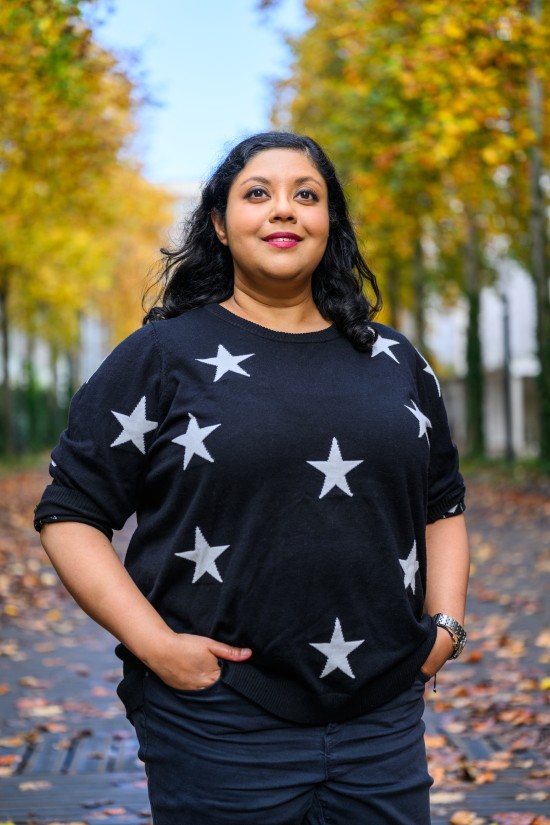
Photo of Premee Mohamed by Michael Meniane, Lensman Studio.