
What if memory was a site of negotiation? What would you preserve, rewrite, re-remember?
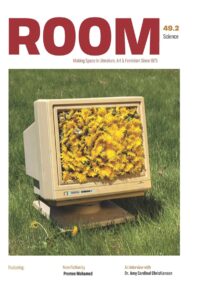
Today, we’re sitting with “Archive Failure: Ethics Board Rejection #924-F” by Abeer Dagher Esber, from our current issue Room 49.2 Science.
Archive Failure: Ethics Board Rejection #924-F
by Abeer Dagher Esber
Residency Application to the Institute of Memory Placement
Applicant: Yasmina (also known as “She Who Refused the Ninth Step”)
Memory Relocation Request: From Damascus to Montreal
Category: Complex Familial Archival / Guilt-Encoded Memory Seeking Spatial Ritualization
- Statement of Request:
I write to the Institute not as a scholar of memory, but as a person haunted by its misplaced weight. I submit this application for the ritual placement of two deaths that demand reckoning—not only because they happened in physical staircases but because they live in psychological vertigo.
Two bodies fell.
Both fell in Syria.
Neither fall had a witness.
And I, the daughter, was present.
Both times.
The first: my mother.
Homs, 1982. A staircase. Rumours. A sister-in-law. I was five. There was no proof, no narrative, only silences and insinuations. Her body broke where the story should have held her. The city digested her fall and produced no report.
The second: my father.
Damascus, 2012. A staircase again. His hand reached for mine; I pulled back. Alzheimer had already taken him halfway into forgetting. I merely completed the sentence. His head cracked on the ninth step. The blood came. The coma. Forty days. Then quiet.
One hot morning, I murdered my father …
This might sound like nothing but Freudian drivel. But it really happened—following a scandal-ridden conflict over a cemetery. We’d just come back from a set of medical exams that had devoured our entire Wednesday morning, and we were on our way up the steps to our house. The heat in Damascus is unbearable: streets packed with checkpoints, insults flying from car windows, ambulance sirens blasting, the sounds of shells in the distance, the barking of soldiers—all of it goads you to commit some major crime in the hope that it might drown out the clamour of a city that’s wilting, suffocating in its own clammy summer fever. In order to put a stop to the incessant buzz, I was going to have to murder somebody. So I did. I murdered my father.
He extended his frail hand, and with the wandering gaze of an Alzheimer’s patient, waited for me to pull him up onto the ninth step of the stone staircase in front of our two-storey home. Only I didn’t. In a fully conscious decision, I withdrew my hand before he could take hold of it. My father grasped the air instead. Then he went down on his back with the full weight of a seventy-year-old man, dark red blood seeping from his right ear. Like the martyrs of the Church, he lay comatose for forty days. Then he died without being able to identify his murderer, or murderess.
I am Yasmina, daughter of Khalil Dagher. Without a regret, I murdered the senile physician, Khalil Elias Dagher, on the morning of Monday the thirteenth of August, 2012, after learning that he had sold the family home to some relative I didn’t even know.
(Abeer Dagher Asber, translated by Nancy Roberts)
I wrote it because it happened. I wrote it because I needed to keep it from becoming myth. I wrote it because the stairs won’t forget until I place them.
– Memory Artifacts to be Placed: The Ninth Step: A mnemonic staircase, carved in Damascene limestone, echoing with withheld hands and unspoken tiredness. Two Invisible Witnesses: My guilt, my five-year-old body. The Bougainvillea: From the Zaytun Quarter house, now a graveyard of memory; it still grows in the folds of my mind, acidic and defiant. A Medical Bag: My father’s tools, filled with the hypocrisy of cosmetic healing and the rot of familial decay. An Ivory Comb: My mother’s used the last time she braided my hair. A lullaby of detachment.
– Proposed Method of Placement: Through the Institute’s Ritual Archival Methodology, I propose the following: Guilt Encoding Translation: Transform both falls into poetic diagrams: lineations of loss overlaid on architectural blueprints of each staircase.Staircase-as-Confession Installation: A physical reconstruction of both stairs, placed in parallel, one from Homs, one from Damascus, connected by a bridge of unsaid things.Whisper Archive Ceremony: An audio installation in which the sentence “I killed my father” plays in different frequencies, layered with the sentence “My mother fell” spoken by a five-year-old girl in Arabic. And finally Mnemonic Release: On the winter solstice, allow these memories to be walked through by visitors in Montreal—barefoot, in silence.
– Why Placement is Necessary: I do not seek absolution. I seek placement—a geography for grief that won’t rot in silence. In Montreal, the cold helps me remember without illusion. It also numbs what Damascus inflamed. But memory migrates poorly. It arrives malformed, missing limbs, speaking only in riddles. This residency is my attempt to archive a pain that still thinks it lives in Syria, and to house it in a colder, quieter city, where perhaps it may speak in a new tongue. Where perhaps I, too, may forgive the daughter who became a stranger in both deaths.
– Final Note to the Archive: Let these two falls—my mother’s and my father’s—be entered not as crimes, but as coordinates. Let the stairs no longer accuse. Let the bougainvillea root itself elsewhere, where its chaos can be beautiful, not damning. I offer this application not just to preserve, but to confess.To confess, not to forget. To forget, not the people, but the burden of their fallings. To place it, finally.
Respectfully,
Yasmina / The Daughter Who Looked Away / Abeer Dagher Asber
**********************************
Institute of Memory Placement
Department of Mnemonic Ethics & Delayed Archival Grief
Refusal of Application #924-F
Subject: The Ninth Step – Dual-Stair Memory Request
Location of Proposed Placement: Damascus to Montreal
Dear Yasmina,
(aka: She Who Refused the Ninth Step, Applicant #924-F)
Thank you for sharing this powerful and deeply personal narrative.
Your application renders memory with the precision of poetic trauma. You narrate the metaphorical and literal deaths of your parents—offering a fictionalized confession of patricide and a lifelong echo of maternal suspicion—and embed them within the architectural and political ruins of Damascus. Your text proposes not remembrance, but reckoning. Not placement, but judgment.
It is this very depth, unfortunately, that obliges us to refuse your application at this time.
Justification for Refusal:
Based on Excerpted Material from FreeFall by Abeer Dagher Asbir
- The Memory Is Still in Motion – “Bloodied with Ink”
You write: “I would screech what I knew. I would shout, rant, retell stories. I would put them down on paper, hot and fresh, bloodied with ink.”
(FreeFall, Ch. 1)
The Institute’s placement protocols require that memories be in a state of narrative stasis before spatial anchoring can occur. Your memories—particularly those of the ninth step—are not archived. They are actively erupting. They bleed, rewrite, and accuse.
We cannot place a narrative that is still screaming.
- Absence of Regret as Ethical Risk
You confess: “Without a regret, I murdered the senile physician, Khalil Elias Dagher…” (FreeFall, Ch. 1) While poetic confessions are admissible, irrevocable declarations of guilt without emotional contradiction (i.e., regret, remorse, ambiguity) pose a risk of haunting in shared mnemonic spaces. Our visitors must not be exposed to unresolved murder that has no intention of healing. Placement is not for the unrepentant. It is for the undecided. And your prose is terrifyingly certain.
- Spatial Contamination from Narrative Overgrowth
You describe your father’s fall: “He extended his frail hand… waited for me to pull him up onto the ninth step… Only I didn’t.” “I withdrew my hand before he could take hold of it.” “He went down on his back… dark red blood seeping from his right ear.” This image, while literary, has already been transferred into language’s permanent archive. The placement site (the staircase in Montreal) would not absorb this memory but instead become infected by it. The red would stain the stone. The hand would hover. Your memory, though complete in confession, is too vivid to be housed without recurrence.
- The Mother-Fall Is Unverifiable and Double-Encoded
Your mother’s death—rumored, unproven, unsolved—has no known coordinates. You offer only this: “They claim she fell on the stairs in Homs… There was a lot of rumor that the sister-in-law pushed her. But, no witness.” Because the event lacks testimonial integrity and spatial fixity, it falls under Category U: Unlocatable Historical Trauma. We do not refuse these memories, but we defer them indefinitely, until a fixed symbolic or architectural proxy can be established.
- The Bougainvillea Has Overgrown the Archive
“My house’s native bougainvillea drove me out to the roadside… She, the house, its legitimate owner. I, the stranger.” Your metaphor, while rich, presents botanical domination over memory form. The bougainvillea has taken on the characteristics of a sentient, invasive grief-form that cannot be housed within our standard protocols. It rewrites placement. It becomes the archive.
Final Determination
The Ethics Board has thus concluded that your memory cannot yet be placed.
Not because it is invalid. But because it is too alive. Too loud. Too literate. We urge you to continue narrating. Not for closure, but for erosion. Let the text wear down the edges of the trauma. Let time—not the Institute—build the landing between your steps. You may reapply when the memory is no longer a scream, but a whisper ready to be filed.
With respect,
Department of Mnemonic Ethics
Institute of Memory Placement
(IMP–Keeping Memories Where They Can Breathe)
**********************************
Subject: Re: Application #924-F – Final Response Request
Dear Department of Mnemonic Ethics,
Thank you for your detailed refusal. I understand the nature of your decision, even if I cannot accept it. I have now received two rejections from the Institute of Memory Placement. You cite narrative instability, ethical ambiguity, and unresolved trauma as justification. But I believe this reflects a deeper truth: your institution is not designed to hold memories still in motion. And mine will not stop moving just to qualify. My father’s fall remains undocumented. My mother’s remains unproven. But both keep replaying. I’m not seeking resolution—I’m seeking placement. Some form of architectural containment. A frame. A room. A shelf. A box that locks. Something. Since your refusal, I’ve begun searching elsewhere for a structure or service that accepts memories as they are: raw, conflicting, ethically gray, without a clean ending. If you know of any parallel institutions—official or underground—willing to receive dual-fall, guilt-encoded memory units with compromised lineage, please advise. If not, I’ll continue my search through art residencies, laundromats, open mics, border crossings, used bookstores, and cracked stairwells.
Respectfully,
Yasmina
(aka “She Who Refused the Ninth Step”)
Montreal / Memory in Transit
Abeer Dager Esber
Pre-order Room 49.2 Science now.