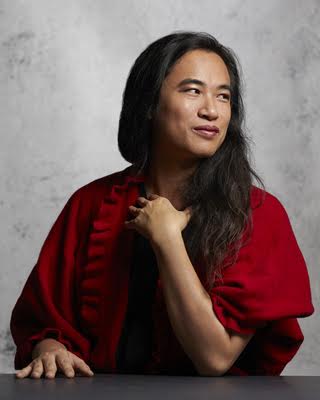
Kai Cheng Thom is above all a storyteller whose distinctive, mythopoetic voice channels something deep, ancient, and wise, all while staying grounded in our present moment and the specificities of her life.
We turn to Thom’s writing when everything, including our relationships and spaces, falls apart. Cheekily at times, she does not give us definite answers and instead asks us to sit with the complexities of our needs, conflicts, histories, heartbreaks, and lives. Through looking at her own place in the world and confronting oppressors with hands outstretched, she reminds us that we collectively have the tools we need, that we can harness them like magic spells or creatures attuned to collaboration, all while making us laugh and cry, interrogating our preconceptions, and entrancing us with reimagined archetypes and fairytales.
Kai Cheng Thom’s latest collection of epistolary poems, Falling Back in Love with Being Human: Letters to Lost Souls, confronts her disillusionment with humanity with tender breaths. Shortlisted for the League of Canadian Poets’ Pat Lowther Memorial Award, these love letters mirror all the parts of ourselves we would rather disavow. In so doing, she beckons us towards something like wholeness, something like holiness—human after all.
Such themes have been present throughout her work from the very beginning, from the electric debut novel Fierce Femmes and Notorious Liars: A Dangerous Trans Girl’s Confabulous Memoir, to her poetry collection A Place Called No Homeland, to her two children’s books From the Stars in the Sky to the Fish in the Sea (illustrated by Kai Yun Ching and Wai Yant-Ting) and For Laika (illustrated by Kai Yun Ching), to her essay collection I Hope We Choose Love: A Trans Girl’s Notes from the End of the World.
Deeply eclectic in her oeuvre, Thom’s forthcoming book, The Shapeshifter’s Guide to Gym Class, will come out with Simon and Schuster in the fall of 2026, expanding her audience to middle-grade fiction readers.
We are excited to have her judge our 2026 Creative Non-Fiction Contest, and equally so to sit down to chat about genre, the vulnerability and craft of truth-telling, and what stories can do.
ROOM: A word when I think of your writing and work in the world is “open-hearted”. The titles of two of your works, I Hope We Choose Love and Falling Back in Love with Being Human, have this rise and fall image: climbing a mountain towards love, and dipping backwards into a trust fall towards humanity. They also remind me of a beating heart. How do you connect with, or stay true to, that beating heart in your writing?
KAI CHENG THOM: What a beautiful way to word this question, thank you! The beating heart, or perhaps the living body in general, is all we have that tells us we are alive. Yet the dominant culture we live in—colonialism, capitalism, patriarchy, etc.—conditions us to ignore the feeling sense of life, conditions us to harden ourselves to our own pain and pleasure and to the pain and pleasure of others. Staying true to love for me is about refusing to be numbed to what my body says about suffering and joy—there is a now-famous quote from Bessel van der Kolk that says “the body keeps the score” when it comes to trauma. I believe that the body tells the truth of all our human sacredness, and that we only need to listen to it in order to rediscover love.
ROOM: It’s exciting to see that you will have a new book out this fall! What did you learn while writing The Shapeshifter’s Guide to Gym Class? What excited, surprised, or challenged you, and what are you hoping young readers take from this work?
KCT: I learned that writing a book is always a terrifying yet enlightening process no matter how many times you do it! I think the most challenging and delightful part of this one was the necessity to think and feel about the story from the perspective of both an adult and a younger person simultaneously. On the one hand, an adult writer’s experience and technical skill should come into shaping a novel for young people. Yet the emotional core of a children’s novel must take children and youth seriously—their intellect, their emotions, and their reality—without talking down to them. My sense is that young readers are often a sharper and more perceptive audience than grown-ups. Adult readers are so easily persuaded that a book is good because other people said so. Young readers, on the other hand, will be honest about what bores them! I didn’t want to let young readers down.
ROOM: In this vein, what does writing middle-grade fiction teach you about creative non-fiction and vice versa?
KCT: Writing middle-grade fiction reminds me that all creative writing (fiction or non-fiction) involves being willing to open up big questions and trusting readers to come up with their own answers. If the author is trying too hard to sell a “moral of the story” to young readers, then the story comes off as preachy and flat, so you have to simply tell the story and let them develop their own conclusions. This is true in creative non-fiction as well, but in non-fiction, it’s easier to try and tie things up neatly in a bow—you can just straight-up tell the reader what to think. Better writing embraces the messiness and ambiguity of the universe.
ROOM: In your interview at PRISM International, you share that the direct address within Sappho’s poetry prompted you to write in epistolary form—what is more broadly prose and non-fiction in our daily lives, and what you describe as a hand “reaching out” to different hypothetical readers, loved ones, figures, or parts of oneself. What do the two seemingly separate genres of poetry and non-fiction teach each other? How does writing one inform the other in your practice?
KCT: For me, poetry is the first language of the heart. Non-fiction prose is the first language of the brain. Poetry invites us to dispense with the formalities and get right down into the depths of feeling. The vehicle of poetry is the closest a writer can get to working with pure emotion, pure sensation, which human beings tend to experience on a primal, non-verbal level. Non-fiction, on the other hand, tends to embrace (or at least consciously play with) formalities in order to achieve a very high level of precision and distinction about ideas. So each involves a different kind of rigor. And of course, non-fiction can be poetic, and poetry can weave in elements of prose, so they influence one another. I like to think it’s best to have both a heart and a brain, rather than just one of the two.
ROOM: Some people say that writing isn’t therapy. Others would disagree. Having been in the therapy world and still immersed in the world of healing today, where do you land in this conversion? What can literature, especially truth-based writing like non-fiction, do for our healing and in especially politically fraught times such as ours?
KCT: I think that all art forms can be therapeutic, but their potential and their role in human culture-making is far broader and deeper than the relatively young and limited practice we call psychotherapy today. Though I am a great lover of mental health and healing practices, I do resent the way that Eurocentric psychology and psychotherapy have come to try and colonize all practices and experiences that involve human emotion, including the arts. Psychotherapy, especially in its more mainstream and conventional forms, is primarily a process that focuses on the healing and daily functionality of an individual—by professional code and by law, there is always a goal of “healing” that is shaped by medical and cultural norms.
Creative writing is a much freer and wilder process. It can heal us, but it also has the power to interrogate—why should we heal? Towards what should we heal? And for whom? So that we can go to work inside of capitalism? Or for something else?
Another key distinction is that therapy is by definition a confidential, private process. It happens between individuals and stays largely hidden; its transformative power is therefore highly limited. The benefit of this of course is that the therapy client is kept safer. Yet the art of creative writing is both deeply private and extremely public—as soon as we choose to share our writing, and to publish it, we bridge the intimate and the collective, and the potential of this to transform culture is both vast and unpredictable.
ROOM: There are many pieces within Falling Back in Love with Being Human, such as the particularly moving “To the Johns,” that express things that many of us know in our gut but is often not safe to say aloud. What advice would you give fellow CNF writers—those hoping to submit to this contest—wrestling with questions of exposure, opacity, and vulnerability within their work?
KCT: I would remind them of the immortal words of Audre Lorde, Black feminist poet and revolutionary, who tells us in her poem “A Litany for Survival” that “when we are silent / we are still afraid / So it is better to speak / remembering / we were never meant to survive.” Your truth holds the key to unlocking not only your own liberation, but someone else’s as well. The great truths that we hold in secret, thinking that we are the only one, are in fact shared by others. Release your truth. It will set us free.
ROOM: What is something a reader shared with you about your writing that you will always cherish?
KCT: Honestly, any positive words from readers strike a deep chord in me and make me cry with gratitude. I still can’t believe people actually read these books/articles/pieces/rants I wrote. However, my very favorite feedback comes from trans girl and trans fem readers who tell me that my novel Fierce Femmes and Notorious Liars was not only meaningful but also fun to read. It is my great aspiration to be both meaningful and fun, and a writer and a person.
ROOM: Who do you read when you feel stuck? Which writers keep you grounded?
KCT: That is a secret!!
ROOM: Taking care of oneself is often an underappreciated part of writing deeply personal works and putting it out there in the world; and perhaps, uniquely, the care required after the work is out and takes on a life of its own. Having published prolifically for many years, what is something you’ve learned about boundaries, self-care, and community-care across the publishing cycle that you wish you had known years ago?
KCT: This is a deeply sensitive and powerful question, thank you for asking it. About having put out my more personal work, I have no regrets, but I do wish someone had told me that writing and publishing one’s intimate truths can indeed have lifelong and unexpected impacts. In particular, I have learned that readers who see themselves reflected for the first time in one’s writing can develop very strong feelings toward the writer, and the more intimate truths, the stronger the feelings. It is a great responsibility, and also sometimes a burden. I wish someone had told the younger version of me that it is okay—necessary, even—to stay human, to be messy, to make mistakes and to keep some truths for myself alone. That is what I tell younger writers now.
ROOM: Lastly, what would you say to writers submitting to a CNF contest for the first time? What are you hoping to read in a winning piece?
KCT: I would tell them not to fear the power of the truths inside them—to not worry about coming across as “cringe” or “sentimental.” I would say that powerful emotion paired with bold command of literary form is always far more interesting than false modesty or “coolness.” I would tell them to trust themselves and not hedge any bets. I am hoping to read a piece that breaks my heart and puts it back together again.