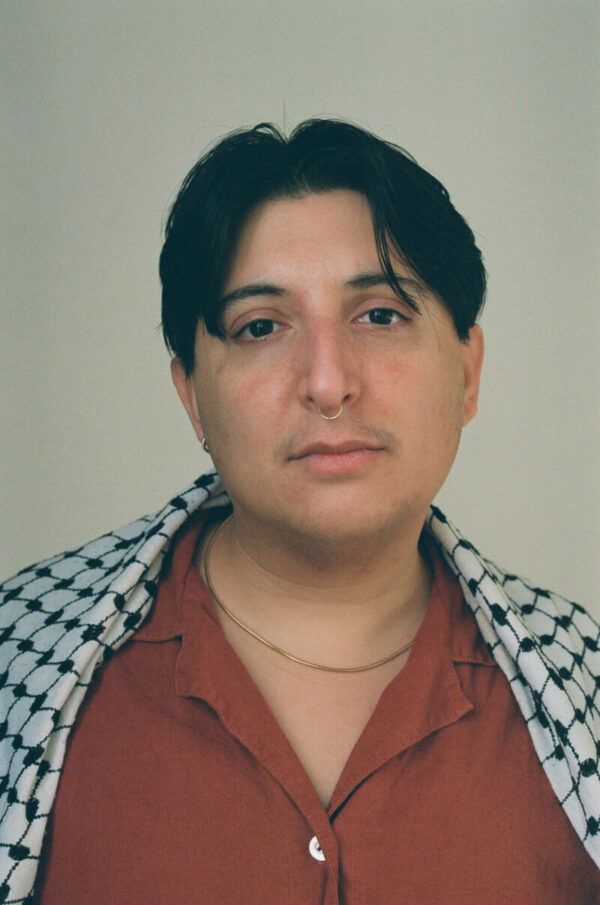
Photo credit: Hamza Abouelouafaa
Eli Tareq El Bechelany-Lynch is one of the rare writers who fluently creates across genres and identities. knot body (Metatron Press, 2020), their debut collection, artfully weaves poetry, essay, and letters throughout to confront how chronic pain, fatphobia, and trans identity shape what it means to live in a body the world wasn’t built for.
Their second collection, The Good Arabs (Metonymy Press, 2021), maps Arab and trans identity through diaspora, desire, and the political weight of being watched. This inspiring collection also recently won the Grand Prix du livre de Montréal, and their translation of Gabrielle Boulianne-Tremblay’s Dandelion Daughter was longlisted for the Dublin Literary Award.
A queer Arab poet and co-publisher at Metonymy Press, El Bechelany-Lynch lives in Tio’tia:ke (Montréal) on unceded Kanien’kehá:ka territory. Their work has appeared in The Best Canadian Poetry, Arc Poetry, and TNQ, among others, and they currently serve as the mentor for the Quebec Writers’ Federation’s 2026 Mairuth Sarsfield Mentorship for Underrepresented Writers.
ROOM caught up with El Bechelany-Lynch after the close of our 2026 Poetry Contest to talk about what it was like to judge, the risks poets took in their submissions, and what’s next for their own work.
ROOM: First, congratulations on an incredible stretch! The Good Arabs won the Grand Prix du livre de Montréal, your translation of Dandelion Daughter was longlisted for the Dublin Literary Award, and you’re now mentoring emerging writers through the QWF’s Mairuth Sarsfield Mentorship. So much to celebrate! How has this period shaped you as a writer?
ELI TAREQ EL BECHELANY-LYNCH: Thank you! Yeah, it has been a great stretch, and to be both recognized for my work and to be read in general. What else could a poet want? I think this period—about six years to my mind; knot body came out in 2020—is really the “professionalization” stage of my career, so to speak. Having books come out means more people knowing who you are and therefore more people asking you to write, edit, judge contests, participate in writing residencies. I’ve wanted to be a working writer since I was a kid, so it’s been nice that the last 14 years of hard work has led here. I’ve been able to teach workshops, and discover and work with other queer racialized poets, and that has been the greatest gift.
I can also see the ways being a politically active and vocal queer/trans Arab writer has shaped my career. I don’t regret being vocal, but it has meant that I think I haven’t been afforded as many opportunities as white or cis writers. It has also meant I still struggle to get paid for my work and make a living off my writing alone.
ROOM: You’ve now read through the entries for Room‘s 2026 Poetry Contest. What was the experience of judging like for you—and was there a moment during the process that surprised you or shifted what you thought you were looking for?
ELI: I’ve judged a few contests within the past few years, though this is the first time I’ve been the main judge. I find reading through submissions so interesting, seeing what people send me and what they think I might appreciate. I really love poetry that is a combination of fun, playful, serious, and poetry that is doing things in fresh ways. I was delighted to see a lot of these qualities in the poems that were sent for me to consider. People seemed to know what I might want to read and that felt delightful.
ROOM: Without spoiling anything for readers who are waiting for results, were there any themes, forms, or risks you saw poets taking across the submissions that excited you?
ELI: One thing I can say I enjoyed is the risks people were taking. People took on “delicate” subjects, so to speak, or wrote about things in new and refreshing ways. I also noticed some formal risks as well. I love when writers really lean into what they’re trying to say or show, without fear of the reader.
I also found a lot of the poems sent to me funny or playful and I loved diving into the different worlds the writers had created.
ROOM: What does a poem need to do in its opening lines to hold you? And what keeps you returning to one on a second or third read?
ELI: I think a lot of the time, people write poems that don’t captivate the reader right away. And by that, I mean they write their poems forgetting to edit those first few lines. And by that, I mean, it can often be useful to cut the first two to three lines of your poems in the editing process because often, those first few lines are the poet thinking about what, how, or why they’re writing. It often reads tentative. I often want someone to launch me into the poem right away, where I’m immersed right from the beginning; I want to feel that confidence coming from the poem. That’s what keeps me interested.
I will reread a poem multiple times when it’s obvious that the poem isn’t giving everything up in that first reading. There’s more buried in the poem, and if I want to discover what else is there, I must reread it. I like meeting poems on their terms in this way.
ROOM: Your own collections move between poetry, essay, and letters—forms blur quite freely in your work. How do you think about the boundaries of what a poem can be?
ELI: When I’ve taught poetry workshops, I’ve often told my students that rules are meant to be broken and that anything can be a poem. People find that daunting; they want me to tell them what is or isn’t a poem. I’m not the expert, or at least I’m not the only expert. I think a lot of things can be poems. But ultimately, I think when a piece of work disrupts the readers’ sense of time and space, when the writer creates images you never imagined could work, that’s poetry to me.
ROOM: You work as a co-publisher at Metonymy Press and you’ve translated Dandelion Daughter from French. How does that editorial and translation work shape the way you read poetry?
ELI: I think my editorial and translation work help shape the way I read poetry, and the way I write poetry. In fact, it might influence the latter in a more tangible way. I’m often influenced by the poetry I’m reading, inspired by a strong voice or a new way of seeing things. I love when poems make me want to write or try new things; it’s probably one of the highest writing compliments you can get from me.
Translation, not unlike editing, makes me think more deeply about word choice; would a different word have worked better here? Is that really what the writer is trying to convey? What do we lose in translation and what do we gain?
ROOM: knot body explores chronic pain, disability, and the limits of language to describe embodied experience, while The Good Arabs explores Arab and trans identity. Do those threads still pull at you, or is your writing moving somewhere new?
ELI: Yeah, those threads still pull at me, but I am also wanting my writing to move somewhere new. I don’t think I’ll ever stop writing about the above-mentioned topics, but if I explore them again, I want to do so in new ways.
ROOM: Are there poets—living or gone—you keep going back to? What is it about their work that stays with you?
ELI: This is nowhere near an exhaustive list of the poets whose work has stayed with me: Bhanu Kapil, Trish Salah, Dionne Brand, Etel Adnan, Ross Gay, Fred, Solmaz Sharif, Zoe Imani Sharpe, June Jordan. I could spend years talking about what I love about all these writers’ work. I could spend five years listing every other writer who has inspired me, including some novelists like Rabih Alameddine.
The through line is that all these writers are playful, political, inventive, and they’re not afraid to try new things. Their work is alive.
ROOM: What are you working on now, or what’s next for you?
ELI: I’m currently working on a poetry manuscript tentatively titled “grief diaries,” a fragmented novel called Leila and the Oud, and a collection of essays about Palestine, Lebanon, the genocide, and Arab art, music, and literature.
ROOM: For poets who entered this year’s contest, or anyone thinking about entering a future one—what’s something you wish more writers understood about how a judge reads?
ELI: A few things: check for grammar and spelling mistakes. It might seem obvious, but it takes me out of a poem when I’m like, that is misspelled, and why are there periods after some sentences but not others? If you’re gonna make a choice, be confident about it and stick with it.
Always try to make the beginning of your poem pull people in.
Be playful and try new things. I’m more likely to enjoy a poem that is being playful in its language and is still a little messy or maybe even unfinished than a poem that is clearly polished and finished but does not play. I want more play in writing, both for myself and for others.
Eli Tareq El Bechelany-Lynch is the co-publisher at Metonymy Press, which running an online fundraiser and a sustainers program to raise necessary funds. Help Metonymy to get back up on their feet, to restart their publishing program, and to begin some new and exciting projects.