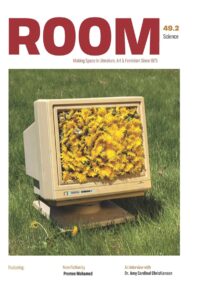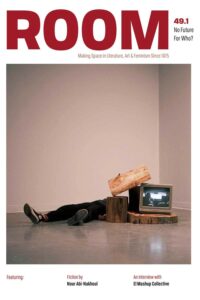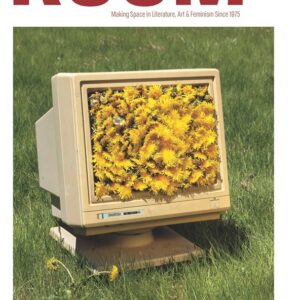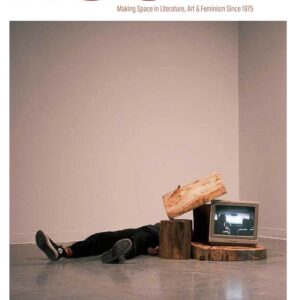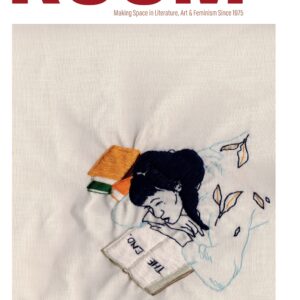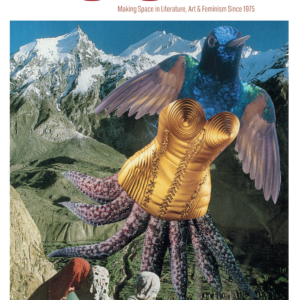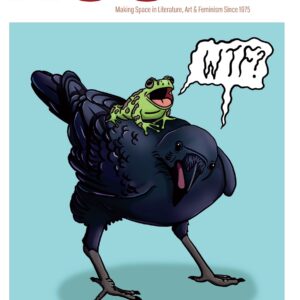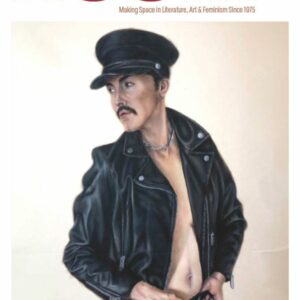
As nationalist sentiment rises alongside a tide of fascism, we at Room have opened our call for submissions for Room 49.3 No Canada, inviting writing and art that presents an alternative lens to sentimental patriotism, interrogates our complicities in imperial violence, draws on decolonial practices and theories, and converses with dissenting voices past and present.
Issue editors Sadie Graham, Vanessa Sanginiti, and Natalie Wee chat about this issue, what we’ve been reading in this time, our hopes for the future, and more.
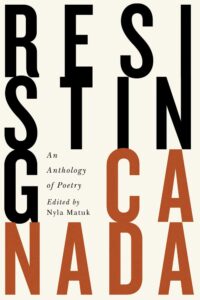
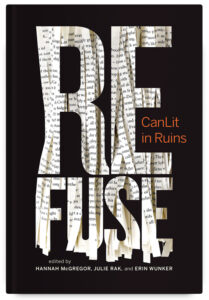
Sadie Graham: What does it mean for a Canadian literary magazine to put out an issue like “No Canada”? We are looking to curate a lineup of literary work about Canada, and about Canadian literature. I’m inspired by the curatorial thinking behind Resisting Canada: An Anthology of New Poetry, edited by Nyla Matuk, and Refuse: Canlit in Ruins, edited by Hannah McGregor, Julie Rak, and Erin Wunker. The poetry and essays collected by the editors at the end of the 2010s narrate, analyze, and feel differently about Canada than our national identity allows. They make room for other stories and other histories. “Poetry,” writes Matuk, “can still be a potent threat to the denialist cultures of settler states.”
At “home” and “abroad,” there are certain fictions, rhetoric, and metaphors about Canada. These are Canadian-made, Canadian-owned and -operated. The aim of this issue is to be more honest. In downtown Vancouver, from one block to the next, you can walk past a row of luxury shops, turn a corner, and step into what’s been called the poorest zip code in Canada. In just two blocks—the violent intimacy of extraction. This psychic whiplash asks us not to see, or think, or empathize, or act. Our issue must do the opposite.
What does this mean, concretely? We’ll find out as we go. For now, here are some pieces that got the wheels turning (or stopped them):
- Canada Park (2015) by Rehab Nazzal | What does Canada mean to the world?
- “Fragments of Suburbia” by Annu Devi in Room 49.1 | How it feels to survive
- “GRETA GUNGEAU CANNOT AFFORD RENT AND WILL KILL HERSELF AT GREY LAB’S FINAL SHOW” by @cathetervevo | How it feels to not survive
- “After ‘listing (v), 2013′” by Chimwemwe Undi in Room 47.4 | What we write
- “On the Imminent Destruction of Portage Place Mall” by Chimwemwe Undi | What we lose
- “Post-Oka Kinda Woman” by Beth Cuthand (in Resisting Canada) | What it takes to keep going
Matuk’s curatorial practice is informed by the idea of a “history from below.” For 49.3, we are seeking a “history from below,” and a “future from below,” as well as a “present from below,” a “present from around the corner,” a “present from nowhere,” and a “present from ‘above,’ as it can only be perceived, understood, revealed, scorned, and satirized by those below.”
Natalie Wee: When we look at “Canada’s” colonial violence against Indigenous peoples, its anti-Blackness and carceral policing, and its complicities in enabling the suffering of those in the Global South—be it destabilizing Sudan or the recent voting down of Bill C-233, No More Loopholes Act—it’s clear that this settler-colonial project is an enemy of life. Room 49.3 No Canada is something I’ve been thinking about for a long time, even before Sadie created this call.
As a writer and artist who’s deeply invested in a future of collective liberation, I’m buoyed by growing movements like No Arms in The Arts and CanLit Responds, by the momentum of arts and cultural workers across multiple coalitions coming together to call for an end to artwashing, by the continued formations of networks of care and global solidarities, and by people protecting each other where the state continues to fail us. More than critiques of how things are in “Canada,” what I’m interested in for Room 49.3 No Canada are visions of alternative futures, practices and praxis that draw on histories of resistance, literature about tearing out from within the belly of the beast, and works that defy borders, genres, form, and the primacy of the English language in “CanLit.”
Lately I’ve been sitting with Rehearsals for Living by Robyn Maynard & Leanne Betasamosake Simpson, which looks deeply at refusal(s) of state violence and “a liberation not yet arrived.”
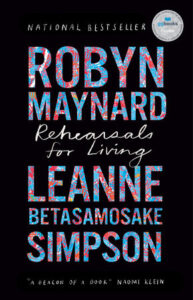
From Rehearsals for Living by Robyn Maynard & Leanne Betasamosake Simpson, via Brick, A Literary Journal
“It would require a deliberate obfuscation to view the racially uneven distribution of harms that the climate collapse engenders as accidental. Even if we didn’t take into account the melting Arctic ice caps, rising sea waters, eroded shorelines, desertification, and species extinctions that are now nearly, if not totally, inevitable, the reality is that not only are an array of world-endings already before us: they have already arrived. Our respective communities have borne, already, multiple apocalypses that were inflicted upon us, if unidentically, from the “barbarity time” of genocide/slavery/settler colonialism. The apocalypse is imagined, after all, in most classic Euro-Western settler tropes, in terms of the lack of clean drinking water, the destruction of the places “we” (they) live, the poisoning of the earth, inhumane and restrictive responses to people left hungry, displaced, in desperation: this is a condition that is already deeply familiar to our kin across Turtle Island and globally.
To remix Public Enemy, “Armageddon-been-in-effect”: it is the apocalypses of slavery and settler colonialism that bind our collective pasts and presents together in the calamity at hand.”
I’ve also been re-visiting “Lessons from the cultural front” by Aliya Pabani and Jody Chan. In the last few years, we’ve seen incredible organizing amongst writers and artists to withhold cultural labour from institutions complicit in genocide, and this article delves into “the publishing industry [as] an active site of imperial politics,” and our role as writers and artists in these times. As a crucial guiding question, the article urges us to think critically about how we can build alternative spaces and sites of possibility.
“Lessons from the cultural front” by Aliya Pabani and Jody Chan, via Briarpatch
“Under what conditions can artists make work? How do we support artists—especially those who are emerging or precarious—who are not only losing work as a result of their political organizing, but also facing the brunt of increasing surveillance and repression? As conditions worsen, how can we resist the allure of self-preservation and affirm Mohammed el-Kurd’s directive to “run toward Gaza, not away from it” with the understanding that there is no ‘other side’ where art can flourish on top of a siege without end, or resolution, or any accounting for what’s been lost?”
Vanessa Sanginiti: It’s strange. It is a heightened time to be living in Canada, particularly as threats of annexation made by the government of our neighbours to the south echo constantly in my mind. I find myself feeling exponentially “protective” now, not of the state of Canada, but of the people who call it home like I do. I navigate this feeling every day, while maintaining a distance from the blind nationalism and pride that is permeating our headlines, news, and media.
Canada has been and will most likely always be home for me. This is precisely why I am endlessly critical of it. For Issue 49.3, I am looking forward to reading pieces that engage with the mixed feelings being “Canadian”—however that looks—currently holds. How can we as writers and artists remain critical of Canada while using these critiques to create a better Canada for us to live in? Is a “better” Canada possible?
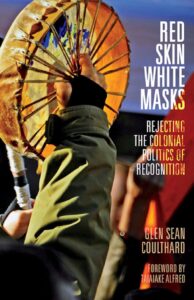
I was first introduced to Glen Sean Coulthard’s Red Skin, White Masks in university. I feel its presence constantly during these times of growing national pride. Released in 2014 and influenced by Frantz Fanon’s anti-colonial work (the title is a direct reference to Fanon’s Black Skin, White Masks), Red Skin, White Masks criticizes liberal notions of recognition and representation, questioning the idea that differences between the state and Indigenous people can be solved or reconciled through this recognition and mere acknowledgment. Coulthard writes about how the politics of recognition directly benefit settler-colonial powers, including the Truth and Reconciliation Commission of Canada.
My hope is that—much like Coulthard does in Red Skin, White Masks—Issue 49.3 can examine alternative ways to reconstruct the value we place in recognition above meaningful action.
Submit to Room 49.3 No Canada now.