April 2026 marks the fourth year since Arab Heritage Month was enacted to the House of Commons of Canada in 2022 under Bill C-232, dedicating the month to acknowledging the histories, cultures, and contributions of Arab Canadians.
This Arab Heritage Month, we at Room Magazine sit with the contradictions of celebrating Arab histories and cultures while grieving how Arab communities are deeply impacted by an imperial violence “Canada” is complicit in. In West Asia, Palestinians continue to resist genocide perpetuated by the same Zionist entity that continues to violently displace the people of Lebanon, and US-Israeli leaders continue to wage war on Iran; in “Canada,” Arab communities face increasing violence, particularly Anti-Palestinian racism and Islamophobia, and in Quebec, a ban on religious symbols.
Over the last few years, many of us in the Global North have all borne witness to the Zionist entity’s mass destruction of lives, homes, infrastructure – a continuation of the entity’s long-standing attempts to destroy the future of a multitude of Arab peoples – and we have seen unwavering resistance from the many Arab communities undergoing unimaginable catastrophe. Arab Heritage Month is an opportunity to reaffirm our commitment to futures where Arab communities can thrive and flourish, and to take material action to do so.
Alongside the reading list below, we urge readers to refer to our resources to support Palestine and call for an end to the US-Israeli war on Iran, and direct financial support to fundraisers supporting mutual aid networks and those forcibly displaced in Lebanon.
Reading list:
Excerpt from “What Happens When a Drone Strike Has No Killer and a War Has No Dead?” by Omar El Akkad via The Walrus, from One Day, Everyone Will Have Always Been Against This
“Language is never sufficient. There is not enough of it to make a true mirror of living. In this way, the soothing or afflictive effect of the stories we tell is not in whether we select the right words but in our proximity to what the right words might be. This is not some abstraction but a very real expression of power—the privilege of describing a thing vaguely, incompletely, dishonestly is inseparable from the privilege of looking away.”
Excerpt from Shifting the Silence by Etel Adnan, via Frieze
“When we name things simply, with words preceding their meaning, a cosmic narration takes place. Does the discovery of origins remove the dust? The horizon’s shimmering slows down all other perceptions. It reminds me of a childhood of emptiness which seems to have taken me near the beginnings of space and time.
Now, dark animals roam in the forest, you could touch them. A particular somnolence takes hold of you when the shadows start groving. Then, the heart creates different beats. You want to touch the leaves, look intensely at each tree. The night falls, already tired, already bare.”
Excerpt from “‘Looking for Palestine in Santiago, Chile’ & other work” by Sarona Abuaker, via Mizna
The flags suffocate us.
In this glittering nightmare I find your palms
and trace the recycled histories as the wave approaches.
There is no redemption in a world created for starvation.
They’ve built this mass grave in a school playground. Reach for me, won’t you? I’ll be here waiting.
Excerpt from “Worlds of Our Own Making,” by Zeyn Joukhadar, via Mizna, from Mizna: Queer + Trans Voices
“The language we use to talk about a person or an event determines the stories that can be told about them. Who is the actor, and who the acted upon? What are the issues, and what is at stake? What is taken as fact? Who is granted the right to exist? Whose humanity is subject to assimilation? Who concedes the verb to identify while snatching away the verb to be? Who is a symbol, and who is a human being? Who is referred to as a person, and who is referred to as a body? Whose bodies are tossed first into the devouring mouth? Do they speak?”
Excerpt from “On the Eve of yet another Nakba, a Dream” by George Abraham via Scalawag Magazine
O you who cannot love us completely, O you who cannot
love even your own selves — we know your gaze, your bitter
witness — we die it every day & tunnel into elsewheres
beyond your wildest dreams! To you I say, another world
is possible for it is here already!
Excerpt from “Home is Elsewhere: On the Fictions of Return,” by Mai Al-Nakib, via Markaz Review
“Home is where I want to lay my bones, on the land where my mother’s bones are buried (I write these words knowing that so many will never know where their mother’s bones are located, an inconsolable grief). We can never return to our first home, our mother’s womb; the best homecoming we can expect is to share the same dirt on the same land as her. Home is the land, not the State — which does everything it can to obscure this ineluctable fact. Home is ancestral, often bloody, but it cannot be stolen, no matter how many bombs are dropped, olive trees uprooted, lies told. But home is also imaginative terrain, slippery, ephemeral, a certain light just out of reach. Our homes are castles in the air, our returns, difficult to trace.”
Excerpt from “If an Egyptian Cannot Speak English,” by Noor Naga, via Literary Hub
“And then Mother placed a single peach on a saucer at the center of the table. With a carving knife, divided it in four. Dinner, she said. My grandmother, whose perfect teeth were singly stolen by a dentist working from his one-room across the river and seating patients on the bed he sleeps in, took all the peach quarters and squished them into her ears. Such greed, said Mother, sucking the hollow seed. Father breathed. Swinging her elbows like a race-walker, Grandmother busied into the kitchen and climbed inside the stove. The next day they placed her collection of paper cranes into the ground with her, so I left. This was ten years ago.”
Excerpt from The Wrong End of the Telescope by Rabih Alameddine, via Literary Hub
“Immediately within the gate to the refugee camp across the road was a large police van, its motor idling, its color a blue so gloomy as to be almost black. I couldn’t look at anything else for a minute. It was a beacon of dark in the light, a big blob of bad color. The kids, still savoring the chocolate, stood on either side of me looking at the same van. They were so big, one of the boys said, pointing at three policemen in full riot gear smoking beside the van, helmets off to make it easier for cigarettes to couple with lips. They had not laid their polycarbonate riot shields down. Big boys with machine guns, batons, vests, neck protectors, knee pads—yes, body armor made your ass look fat. They didn’t speak English, another boy said, or Arabic. They didn’t talk except to each other. The cinder block wall next to the gate shouted defiantly: NO BORDERS NO NATIONS in red graffiti.”
Excerpt from “Letter to June Jordan in September” by Lena Khalaf Tuffaha, via Mizna
“I met a girl from the camp at a reading in Beirut. She asked if we could talk about the life of poetry. Our families are hauled off to the world of the dead, and every day it is on screen. In Gaza, we’re watching Ferguson, and in Atlanta we’re watching Jerusalem watching Minneapolis watching. Their weapons and their training programs indistinguishable. The word almost flickers for a nanosecond. Here I note the shelf-life of self-censorship, legacy of our era. Some days poems are scrawled on pieces of cardboard and carried on our shoulders at the protest like martyrs. Here I should say something about hope. Here I should say something about living.”
Excerpt from Frankenstein in Baghdad by Ahmed Saadawi
“The explosion took place two minutes after Elishva, the old woman known as Umm Daniel, or Daniel’s mother, boarded the bus. Everyone on the bus turned around to see what had happened. They watched in shock as a ball of smoke rose, dark and black, beyond the crowds, from the car park near Tayaran Square in the center of Baghdad. Young people raced to the scene of the explosion, and cars collided into each other or into the median. The drivers were frightened and confused: they were assaulted by the sound of car horns and of people screaming and shouting.”
Excerpt from “Diary of a Wave Outside the Sea [Excerpt],” by Dunya Mikhail, via Poetry.org
“Through your eye
history enters
and punctured helmets pour out.”
Excerpt from “An Interview with Fargo Nissim Tbakhi,” by Summer Farah and Fargo Nissim Tbakhi, via Poetry Project
Fargo Nissim Tbakhi: Something I think about in particular in “Craft Talk,” is that every failure is also a success. What I mean by that is the ethical and political failures that I’m demonstrating in that poem are also me, or the speaker, being a successful poet. Our collective failure to stop the genocide of Palestinians is also our success at being neoliberal subjects. The understanding of the world’s foundation being contingent on the brutality against Palestinians means that every time we don’t stop it, we are being good citizens. I feel the same way about the idea of ethical failures in writing. More often than not, [that] means we are successful writers. We are good “literary citizens,” for example, a phrase that I find truly repulsive, but actually useful. It comes with all the violence that a citizenship contains.
Excerpt from “The Road to Ramtha,” by Sanad Tabbaa, via Mizna
“One of the nice things about being a writer is that you get to start a story whenever you like. I could start this story in 2017, when a combination of a nerve pinch, cancer, and aging macular degeneration forced me to become friends with my grandad. I could start it the February before last, when he broke his leg and we spent long nights together in Khalidi Hospital, him fucked up on morphine and me obsessively playing Hand on Jawaker. I could start it yesterday, on his deathbed, but I won’t. I’m going to start this story on our way to Ramtha.”
Excerpt from “All the Names We Will Not Know” by Naomi Shihab Nye, via Poets.org
Before dawn, trembling in air down to the old river,
circulating gently as a new season
delicate still in its softness, rustling raiment
of hopes never stitched tightly enough to any hour.
Excerpt from Beirut Hellfire Society by Rawi Hage
“One sunny day at the start of a ceasefire, a father drove with his son down towards where the fighting had been. A cadaver had been lying on the ground for days, mutilated. The son, who was named Pavlov, and his father, an undertaker, loaded the remains into plastic bags and carried them to the hearse. The cadaver’s belly had been opened by a bullet wound and vermin had claimed it and multiplied inside the soft organs, gorging on the entrails. Father and son gathered the scattered items that belonged to the dead: a loose shoe, a bag filled with mouldy food, broken glasses.”
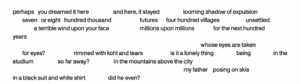
Excerpt from “Composition: give up your own” by Trish Salah, via C Mag
Excerpt from “The World’s Loneliest Whale Sings the Loudest Song” By Noor Hindi, via Split This Rock
“I won’t make metaphors out of fish. If I have to die, I choose the ocean. If I have to live, I choose you. You: Everyone I’ve ever mourned.”
Excerpt From The Locust and the Bird by Hanan al-Shaykh
“It all began on the day that my brother Kamil and I chased after Father, with Mother’s curses ringing in our ears. I hoped and prayed God would take vengeance on him. He’d fallen in love with another woman, deserted us, and married her.”
Excerpt from “I Belong There,” by By Mahmoud Darwish, via Poets.org
I belong there. I have many memories. I was born as
everyone is born.
I have a mother, a house with many windows,
brothers, friends, and a prison cell
with a chilly window! I have a wave snatched by
seagulls, a panorama of my own.
Excerpt from “You Will Not Kill Our Imagination” by Saeed Teebi, via The New Quarterly
“One of the most terror-inducing aspects of writing is how much of it is an act of faith. It requires the writer, while they are alone conjuring words on a screen, to believe that the experiences of which they are writing, no matter how idiosyncratic, will strike readers as familiar, resonant, or interesting. The belief is made less foolhardy only by the knowledge that readers possess imaginations to assist them in navigating different worlds.”
Take action:
- Resources to educate, take action, and aid Palestine
- Call for an end to the US-Israeli war on Iran
- Donate to mutual aid for Lebanon and Mutual Aid To Support Those Forcibly Displaced In Lebanon.
Correction:An earlier version of this article’s reading list for Arab Heritage Month presented writers from the SWANA (Southwest Asia and North Africa) region and included Iranian poets, who were incorrectly conflated with Arab writers. We thank the community for calling us in regarding this crucial error, and have since edited and expanded this Arab Heritage Month reading list to correct it. Room sincerely apologizes and recommits to moving forward in solidarity with more knowledge and clarity.