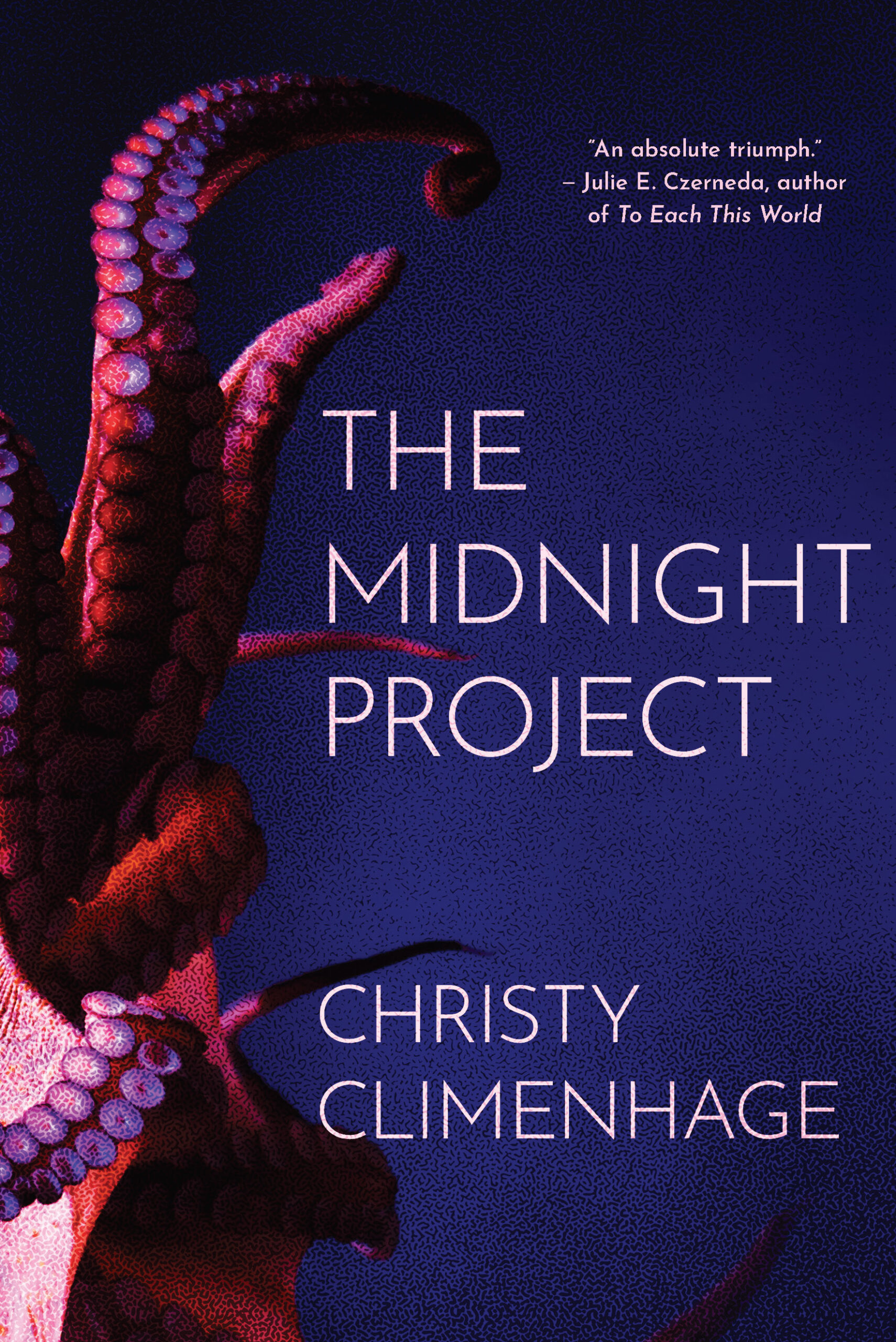
The Midnight Project
by Christy Climenhage
Wolsak & Wynn
294 pages
$24
The genetic engineers in Christy Climenhage’s speculative novel The Midnight Project carry enormous guilt over the unintended consequences of their earlier work. Formerly employed in the agricultural industry, Raina and Cedric are painfully aware that the impending collapse of Earth’s pollinator populations has their fingerprints all over it.
They’re given a chance to save a remnant of humanity—but that remnant will not be entirely human, and it is precisely the human part that may be most worrisome. “You see it all over the news,” muses Cedric. “Humans are the worst. We’ve driven ourselves off a cliff and are just watching the scenery go by, waiting for the impact.”
The near-future world these scientists inhabit is holding onto a veneer of normalcy, but it’s fraying at the seams in ways that unnervingly parallel our present moment: supply chain shortages, extreme weather events, and a biodiversity crisis. Climate change has been solved, but as Raina and Cedric’s dubious benefactor Mr. Sykes observes, “With the pace of scientific change now, we can no longer control outcomes . . . we have accelerated our learning and our technology to a point where we are creating new conditions for our own downfall.”
The Midnight Project captures both the thrill of scientific discovery and the slide into murky ethical decision-making that can result from obsession. Petty motives of professional jealousy and personal pride also factor into Raina and Cedric’s choices. As Cedric notes in a moment of moral clarity, “You know . . . getting revenge on an evil conglomerate by doing a secret project for another conglomerate may not be the flex you thought it was.”
Climenhage’s debut isn’t without its flaws. At times, the mechanics of storytelling are rendered too visible. The author has a tendency to telegraph her use of foreshadowing rather than letting the readers figure it out for themselves. Sinister implications of events are spelled out in detail through lengthy disquisitions. Villains are blandly villainous, while side characters are rarely developed beyond just their names. Even Cedric, one of the main characters, is sometimes reduced to a singular trait: his anxiety. Yet for all that, The Midnight Project is undeniably propulsive, and the action unfolds like a classic page-turner.
As much as The Midnight Project is a cautionary tale about scientific excess, it’s also a celebration of the miracle that is consciousness. Perhaps the most engaging characters are the genetically crafted creatures whose minds exhibit sufficient humanity to meaningfully communicate with us, yet are alien enough to manifest truly alternative ways of knowing. Even as the book serves to warn and critique, it opens toward wonder.