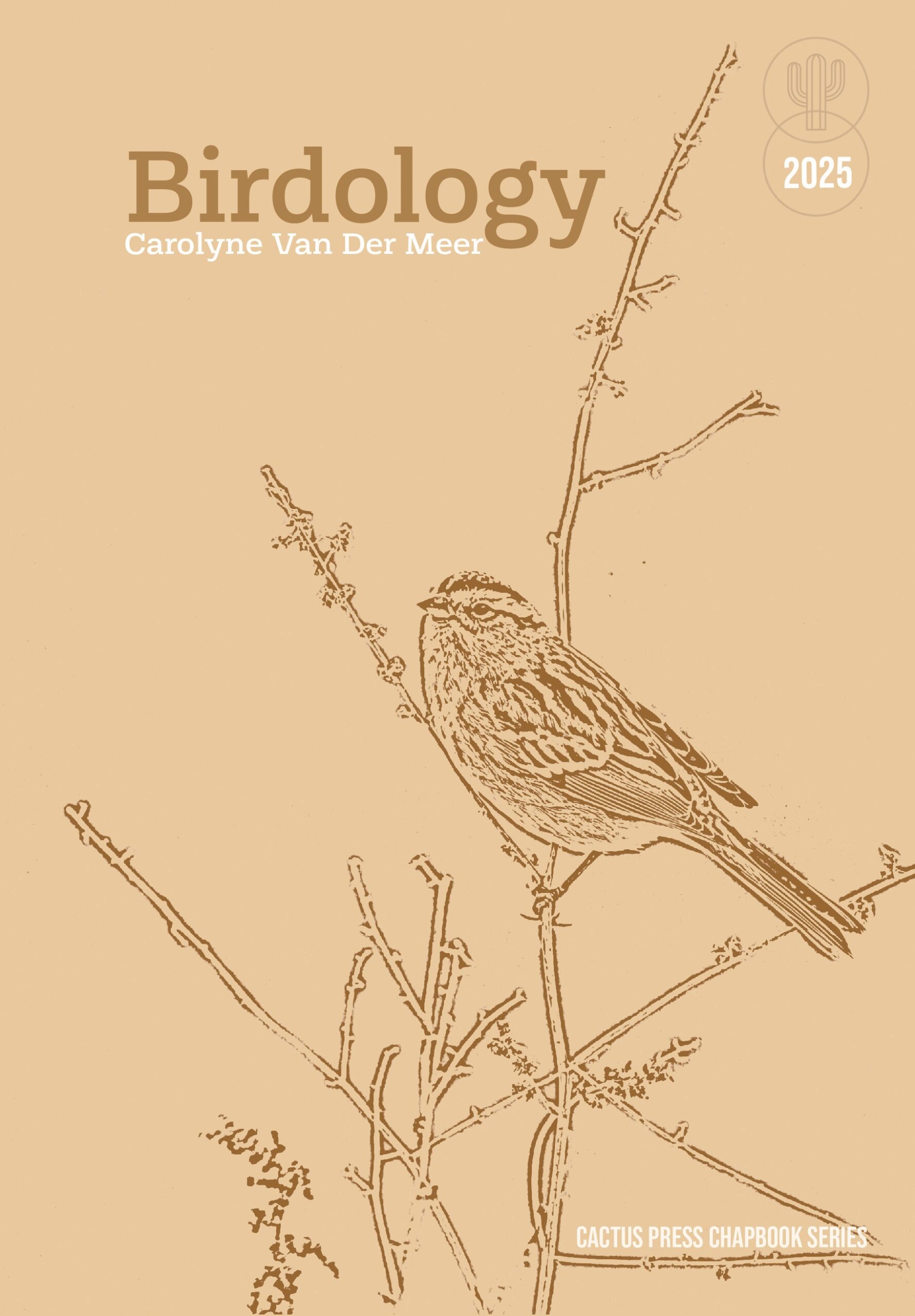
Birdology
by Carolyne Van Der Meer
Cactus Press
26 pages
$10
Comprising 14 works of flash essays and poems, Birdology is Montreal poet Carolyne Van Der Meer’s fifth collection. Using sparrows and their folklore as a starting point, Van Der Meer connects the lives of various animals—turtles, sparrows, pigeons, and a doe—with her own personal losses. Her observations of the natural world become a means to grasp and articulate what she’s experiencing as her loved ones approach death.
Her skillful weaving of these seeming disparate species and circumstances is striking from the first poem, “Birdology I”: “I made a decision that morning not to help the pigeon . . . I kept walking and didn’t look back. / I couldn’t help wondering if we do the same with our elderly.” She identifies her father-in-law, family friends, and mother before concluding: “I cry for the pigeon I chose to leave behind and wonder about all the other choices I could have made, could still make.” This pattern—where moments from walks and drives lead her to reflect on anger, frustration, illness, and death—recurs throughout the collection.
In Birdology, Van Der Meer moves from park settings and highways to the complicated nature of relationships and the challenging choices we must make; the losses and grief we each experience, the leaving of loved ones. In “Breviary II: Sublunary,” she writes: “Sometimes we mourn them as if they’ve gone but it’s / more than that we have trouble recognizing the loved one stripped bare of belongings weight memory autonomy.”
These sensuous poems brim with specificity; their images linger, engage the reader, and create empathy, as in “Birdology II” where we experience the fullness of our choices: “On our way to run errands, we passed a parked car and heard splashing. A look down revealed a host of house sparrows bathing themselves in a convenient puddle . . . Sometimes we don’t know what awaits us. How suddenly, on a random day of puddle splashing, there is also a feeling of bereftness that cannot be contained.”
Van Der Meer then returns to the ongoing issue of her mother’s need for care: “And as my mother gives in and says a care home is the only next step—a place of antiseptic loneliness, its dotted line the one I sign on . . . There is nothing weighing down the sparrows in their puddle, no sadness that I could discern. They flapped their wings, flicking the water off their little bodies, and dove in again.”
Van Der Meer’s insight, passion, assurance, and skill are evident in this small, focused collection. We can learn from the sparrows. Van Der Meer shows us the way.