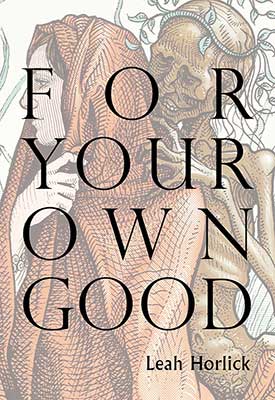
Leah Horlick’s second collection of poetry is a fictionalized autobiography that focuses on a violent lesbian relationship.
Leah Horlick’s second collection of poetry, For Your Own Good, is a fictionalized autobiography that focuses on a violent lesbian relationship. Following her debut Riot Lung (Thistledown Press, 2012), this second volume reads in some ways like a response to the first. Exploring typical coming-of-age themes—family, home, and sexuality—Riot Lung culminates in the unfurling of a new relationship approached by the speaker with trepidation. For Your Own Good picks up after the beginning of a love affair, which quickly becomes abusive.
The author courageously tackles the neglected topic of violence in lesbian relationships, using her own experience as inspiration. The book’s speaker is direct, enumerating details both concrete and abstract, but never with ambiguity. Notably, the poem “The Disappearing Woman” reads as a kind of diagnostic manifesto on the theme, juxtaposing an “invisible” abuse with the typical image of domestic violence:
With her new magic, she makes you
invisible.
The women with black eyes
do not see you, in your bare
sleeves, your tired, unmarked face.
The women with black eyes
can say doorknob. Can say staircase
and fell down.
This poem explores some of the stereotypical attributes of violence in heterosexual relationships, establishing a kind of foil for the speaker’s own experiences, and the unseen suffering in abusive lesbian relationships.
Despite its difficult subject matter, For Your Own Good is more reserved in some ways than Riot Lung. Though Horlick maintains her ornate, almost baroque style, the speaker’s voice is less naive and overwrought. Indeed, there is something cool about the way she relates her abuse, suggesting the distance that comes with the passage of time. For example, she writes, “Now that I know what to call what / you did, come back here and I’ll do it right this time.” Still, the scenes are often difficult to read, teeming with unsettling details, as in the poem “Captivity”: “She names herself keeper, alpha. Grabs / your breasts to make you hiss for strangers. / You’re the mirror that makes her look skinny, the whip she cracks for show.”
What makes pieces like these bearable is the knowledge that, ultimately, Horlick’s story is one of survival. Through friends, poetry, and endurance, the speaker finds a way out, and even finds love again. As a narrative of transformation, For Your Own Good deftly maps the vicious “magic” of abuse and the relief that comes with healing, all in Horlick’s intimate, urgent voice.