
Every Black Futures Month & Black History Month, we republish brilliant works and conversations with Black organizers, writers, and artists from Room‘s past issues, to live on our site in perpetuity.
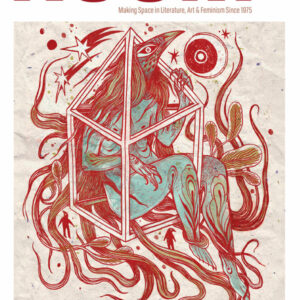
Today, as we reckon with the world in its current state, we’re sitting with Oluwatoke Tunde-Adejoye’s “Red Girl” from Room 48.3 Rest/Unrest, which asks us to reflect on migration, lineage, grief, power, and choice.
“Red Girl”
by Oluwatoke Tunde-Adejoye
first published in Room 48.3 Rest/Unrest
Vancouver, Canada, 1999
She is to leave many things that deserve to be mourned behind, but it is the reality of her son’s last day of school that grips her the most. They leave Canada permanently for Lagos in a week, although she has lied to everyone that the trip is just a long summer holiday. She should have found a new primary school in Nigeria for her son by now, or at least a shortlist of schools, but she has not been able to bring herself to do anything other than pack and repack, faced with the impossible task of folding eight years of her Canadian life into five suitcases.
What should be her final dental appointment is also today, but now that she is two blocks away from the dentist’s office, which is sandwiched between a quaint gem shop and a Starbucks drive-through, she decides that it is not worth her time and makes a U-turn for her condo, a fifteen-minute drive away. She has always liked this part of the city, the beating heart of downtown Vancouver—emerging from her condo in the mornings and melting into the throng of breathless pedestrians oozing out of the Burrard SkyTrain station has always been the perfect setting for her to pretend that her life is just as hectic as those strangers’. And there is the bridal shop on Robson that always beckons to her with pearl-encrusted dresses and fluttery veils sealed off behind glass walls, but she has to hold herself back every time she passes because she is just an army general’s mistress hiding two continents away from home, trapped in the amnion of comfort to dull the pain of her shame and loneliness. She will miss the shop.
⎯
The General called from Lagos four months earlier with the news that she was to return to Nigeria, now that the country was returning to democracy after over a decade of military rule.
“Once the new president is sworn in, everything will change for us,” he said. “My accountant has been on my neck to cut down unnecessary expenses.”
“What do you mean by that?” she asked. She knew that president-elect Olúṣẹ́gun Ọbásanjọ́ would be sworn in the next month but had not given it much thought, like any news from home since she left. The static was mild, but the General’s voice was distant. The phone receiver was slick from her sweaty palm.
“What?”
“Unnecessary expenses.” Her voice trembled slightly as she repeated the words. The twenty-five-year age gap between her and the General had made it impossible for her to question him in the past.
“Do you think I pay toilet paper for your apartment?” he scoffed.
She felt the bite of his words. “Your son lives in the apartment too.”
The General’s sigh crackled on the other end of the line. “I have properties in Abuja, Lagos, and Port Harcourt. Bring my son home and choose any house you want.”
“What about your wife?”
“My wife?”
“Is she not in America with your children? Have you told her to pack up and return to Nigeria?”
“You’re angry.” The General’s tone was of both surprise and mild irritation, like that of an adult stuck with a tantrum-throwing child. “How many of your age mates can boast of your lifestyle—”
She hung up before he finished.
She had spent nearly eight hours the evening before getting her hair braided. Tylenol dulled the discomfort through the night, but the General’s words pricked her still-tender, still-healing scalp like needles. She found herself in her bedroom without really remembering how she got there from the sitting room. Turning on the light would worsen her headache, so she groped her way in the partial darkness of dusk until she sank into the plushness of her bed. She realized now, with palpable disgust, that she was a coward. She should have put up more fight and confronted the General about his flat in Amsterdam where Halimat claimed he was keeping his latest mistress. Her disgust turned to self-rage. She reached for the pair of red scissors she kept in the lower drawer of her nightstand and, without hesitation, began to cut off her braids.
Halimat—her only Nigerian friend in Canada—was a trove of fresh gossip and insider tales. Halimat’s uncle was also in the Nigerian Army, and some of her cousins were married to high-ranking officers. Deep down, she did not like Halimat. Halimat was brash, with an attitude Nigerians called “too forward.” Back home, they would never be friends, but this was Canada, where being a foreigner forced you to make compromises on the quality of friendships. You took whatever was thrown at you. Halimat was the only person to ever point out that men like the General preferred to settle their wives and mistresses in England and America.
“But there’s nothing wrong with Canada,” she replied, resisting the urge to tell Halimat to stop talking with her mouth full of yam and garden egg sauce. Halimat had invited her for lunch in her house that day.
Halimat persisted. “I’m just saying that England and America are the big leagues. Maybe he doesn’t want you in those places because he already has other women living there? But America is a big country. You can live your life peacefully in a different city without ever crossing paths with his other mistresses.”
She had a feeling that by mentioning other mistresses, Halimat was purposefully trying to trigger a reaction from her. She ignored the bait, stabbed a slice of yam with her fork. The yam was a perfect circle, soft, and salted to perfection.
“You’re not saying anything,” Halimat pointed out.
“There’s nothing to say.”
⎯
A week after hanging up on the General, she drew up a list of her jewellery that would fetch her money at a Cash for Gold place. She doubted it would be useful in Nigeria. After eight years of being away, she had no social circle or friends to invite her to parties. She tried not to worry about what would become of the condo she’d deluded herself into thinking belonged to her all these years. The General’s accountant would advise him to sell or rent it. Or maybe it would sit empty until the General found a new mistress. She imagined this new mistress sleeping in her queen-sized bed—the bed that she hand-picked at Sleep Country a little over six months before, after weeks of careful deliberation.
Eventually, she diverted her attention to the magnetic calendar on the silver refrigerator in her kitchen. Colourful fruit-shaped magnets swirled around the calendar, on which important dates were circled with a Sharpie. Her son’s swimming lessons in the community centre. Soccer practice. Pedicure appointment. Dental appointment. Summer trip to Banff. She yanked the calendar off the fridge with enough force that it sent the plastic fruits flying. She sank to the floor, her tears catching her by surprise, wishing there was someone, anyone, even if it was Halimat, to hold and comfort her.
⎯
She met the General in her final year at the University of Lagos, straining under the weight of her finals, job prospects, and the torturous knowledge that the connected kids in her class had already secured placements for their National Youth Service year in the big shots like Coca-Cola, Nigerian Breweries, and Chevron. For someone like her—whose father, in the aftermath of losing his job at a glass company that went bankrupt, became a full-time pastor in a neighbourhood Pentecostal church, and a mother who sold cheap baby clothing imported from Türkiye—her fate was to be posted to a rural secondary school tucked away in an obscure village.
The night she went clubbing with her best friend, S̩alewa, in Maryland, the General and his friends were on the upper floor of the club with a whole table to themselves. It was S̩alewa who preferred older men, not her. But somehow, while she and S̩alewa danced, her eyes and the General’s met more than once. She returned to campus with his card in her handbag. In the weeks that followed, the General would send his driver to campus to pick her up and bring her to a guest house in Ikoyi—one of the exclusive types with no signboard. They would empty two bottles of wine between them, while his aide sat a few tables away. He did all the talking. Politics. The stress of sating the horde of people who always came knocking at his door for financial assistance or help with jobs and contracts. She listened, smiled politely when she needed to, and laughed when the occasion called for it. She was just a twenty-year-old. What did she know about the world?
“Everybody always wants something from you when you’re in a position of power,” the General mused one day, observing her over the rim of his wineglass as though he could sense that she too had an agenda, a favour to ask of him. “The problem is that so many people are entitled. Imagine offering to sponsor your driver’s children to go to university, and the man asks if I can send the children to school in America instead?”
She laughed charmingly at the same joke he had told too many times. Deep down, she doubted if any driver would be stupid enough to say that.
Their first time in bed, he had a set of new red lingerie waiting in the bedroom for her and asked her to change into it. Afterward, she lay awake until dawn, acutely aware of how her bare skin held his Arabian perfume in a tight fist. It would become their ritual, new red lingerie always spread out on the bed before her arrival. She would take it back with her to campus, sit on the edge of her narrow bunk bed, and shred the expensive lace into pitiful strips with a pair of scissors. She never questioned the General about it. She perceived it to be beyond something as simplistic as his favourite colour and eventually concluded that she could not be the only girl he was having an affair with. Perhaps he assigned a different colour to each girl because he could barely keep up with their names. Pink girl. Blue girl. Green girl. Purple girl. Maybe that was how he and his friends talked about their lovers. I’m spending this weekend with my red girl, she imagined the General saying, or, Yellow girl disrespected me last week, so I’ve ended things with her.
Three months into their affair, she discovered she was pregnant. The General moved her out of her campus accommodation to a furnished one-bedroom flat in the nice part of Yaba. Her pregnancy, alongside the flat—with its alternating sky-blue and custard-yellow vinyl tiles, frosted glass doors with flower engravings, and pots of tradescantia purple passion lining the steps to the front porch—represented her irrevocable initiation into the world of being the General’s recognized mistress. She was no longer just the girl he met at the club. Whenever S̩alewa visited her on weekends, they indulged in endless rounds of Ludo over chilled Fanta and plates of suya, or gossiped about which male lecturer was sleeping with a student they knew. They never talked about how she would break the news to her parents, even though it charged the air they breathed like electricity. It was a forbidden topic by mutual, unspoken agreement. Things remained the same, until in her second trimester, the General, on his own, decided that she was to have the baby in Canada.
⎯
On the morning of their 5:50 p.m. flight from Vancouver to Lagos, Halimat calls with an offer to drive them to the airport. The drive from her apartment to the airport is roughly forty minutes and she fears that spending that much time in Halimat’s car could make her slip and weaken the foundation of the lie that she has so carefully laid for the past couple of months. She accepts the offer reluctantly.
However, the drive to the airport is smooth, except that Halimat will not stop talking about their plans for a Christmas road trip to Seattle with their children. She has to force herself to match Halimat’s level of excitement, a task she finds draining to the point that she fears she might collapse before they reach the airport.
“I envy you,” she blurts out in a passing moment of weakness.
“What do you mean?” Halimat asks.
“You don’t have to endure a twenty-two-hour trip to Nigeria for summer vacation,” she says, quickly catching herself.
Halimat chuckles. “On the bright side, you’re coming back with goodies.”
What she truly means is that Halimat is not bound to an unpredictable lover, and her life is firmly rooted in one place. Who is to say that after returning to Nigeria, the General will not impose more changes on her? She raises her head to look at the green overhead highway sign that reads “YVR Vancouver International Airport.” The pit in her stomach deepens.
At the airport, she and Halimat hug, and peck each other’s cheeks. Halimat hugs her son too and promises to see him in a few weeks. Her son sleeps throughout their waiting time after checking their luggage and going through security. When the boarding call for their flight finally echoes through the speakers of the lounge, her son is still fast asleep, his face so peaceful that it feels like a crime to wake him. But she should wake him so that they can join the queue at the boarding gate. Instead, her mind is replaying what the General once told her.
I like you because you always do what you’re told. You’re a good girl; you were raised well.
The when and where of the memory are fuzzy. Only the words are clear, almost as if he were right beside her now, repeating them.
A sense of clarity emerges from the murky waters of this unexpected memory. She realizes that she has some money in her Canadian bank account—years of generous monthly allowances from the General saw to that. She wonders if she can rent a modest one-bedroom apartment by herself and find a job to take care of herself and her son. She is afraid that she might fail, that defying the General is a recipe for disaster. Yet she cannot deny that the last thing she wants now is to board the plane and strap herself into seat 6C while the pilot drones on about altitude and weather in a barely audible voice. So she leans back and blocks out the airport noise and the General’s expectations. She does not want to worry about their checked suitcases for now. They are dead weight. She glimpses a smile on her son’s sleeping face and takes it as a good sign.
Read our 2026 Black History/Black Futures Month Statement and Reading List here.
For more works that confront the tension between deep injustice and the necessity of recovery, order Room 48.3 Rest/Unrest now.