Endsickness
by Sofia Alarcon
Conundrum Press
150 pages
$25
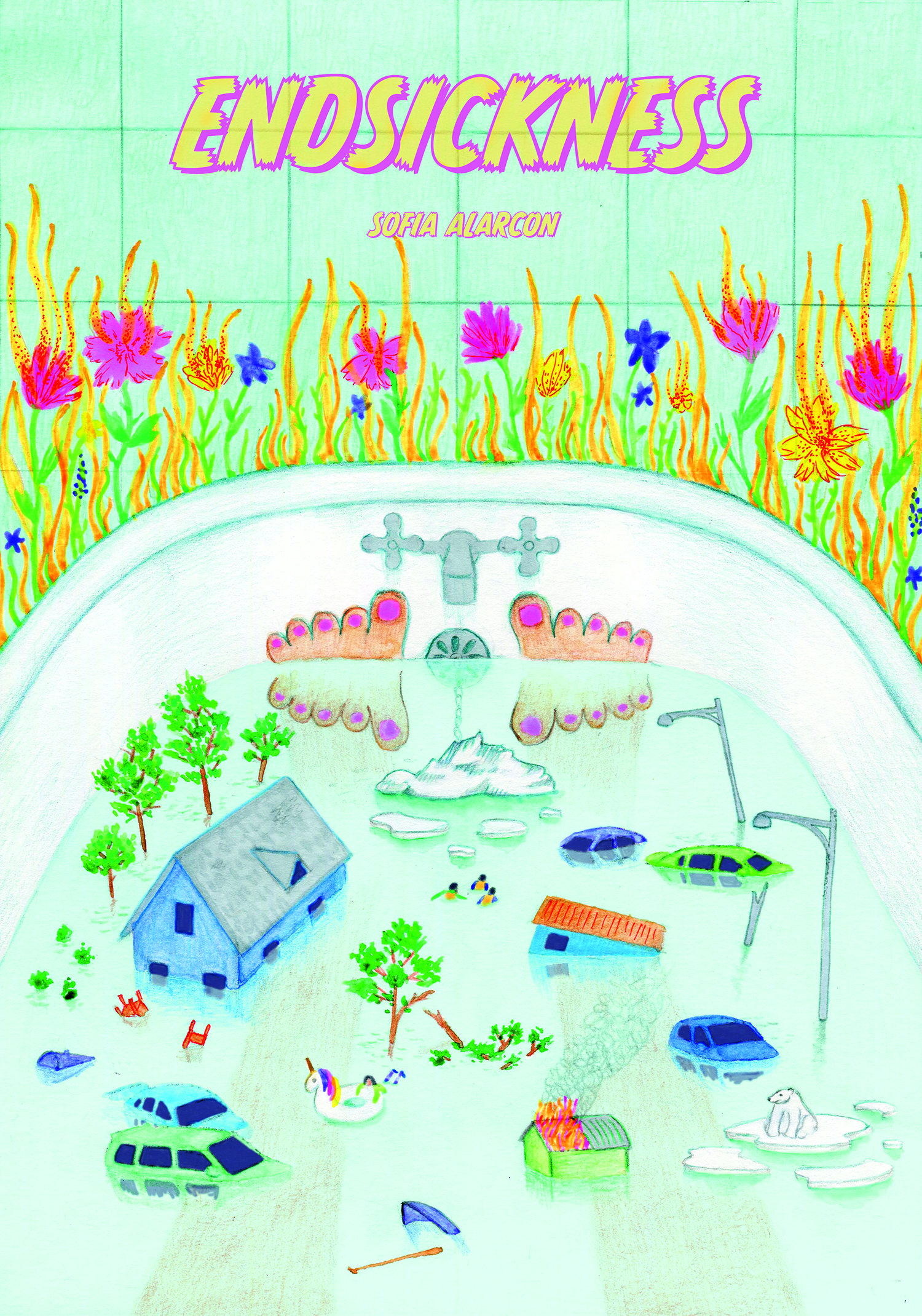
The cover of Endsickness, Sofia Alarcon’s debut collection of graphic stories, pays homage to Frida Kahlo’s 1938 painting What the Water Gave Me, often considered to be her first surrealist work. In Kahlo’s piece, her legs appear in a bathtub filled with water, surrounded by objects that represent key moments of her life, many of them traumatic. Alarcon reimagines this scene with a pair of legs encircled not by personal memories, but collective trauma—one humanity has caused the earth—through the form of a climate disaster: a flooded house, submerged cars and trees, a sunken boat.
Following the same playful but deeply layered style of the cover, the collection explores the anxiety of living in an age where climate change threatens both humanity and the planet’s survival. Across eight moving, profound, and funny stories, Alarcon condenses vast and complex philosophical questions into human-sized narratives that emphasize the mundanity with which we are moving toward climate extinction.
From the very first story, “Positive Thinking,” Alarcon sets this tone. In it, a woman repeats the same monotonous daily routine, all while reciting positive affirmations to herself like mantras: “I deserve my dreams,” “All is well in my world,” “I am a warrior.” However, in the next panel, we see her real state of mind as she fantasizes about escaping into the wilderness and returning to a primeval state. The story illustrates the absurdity of positive messaging that rings hollow in the face of climate disaster, while still acknowledging that positive thinking is one of the few ways we can continue to live in the face of imminent crisis.
In “Adaptation,” an epic tracing the history of evolution from amorphous micro-organisms to humans in the present day, Alarcon contends with the vertigo of trying to understand the universe’s interconnected nature, the immensity of time and space, and the extreme improbability of life—only for humans to waste their lives in a meaningless pursuit of physical and economic survival.
The large scope of “Adaptation,” as well as that of many of the other stories, reflects the difficult space most of us inhabit between powerlessness and personal responsibility in confronting an issue as large and existential as climate change. Written in a calm, almost conversational style, and accompanied by illustrations that are poetic, sophisticated, but also at times humorously childlike, Endsickness succeeds in capturing the acute but indefinable malaise of modern life in the early twenty-first century.