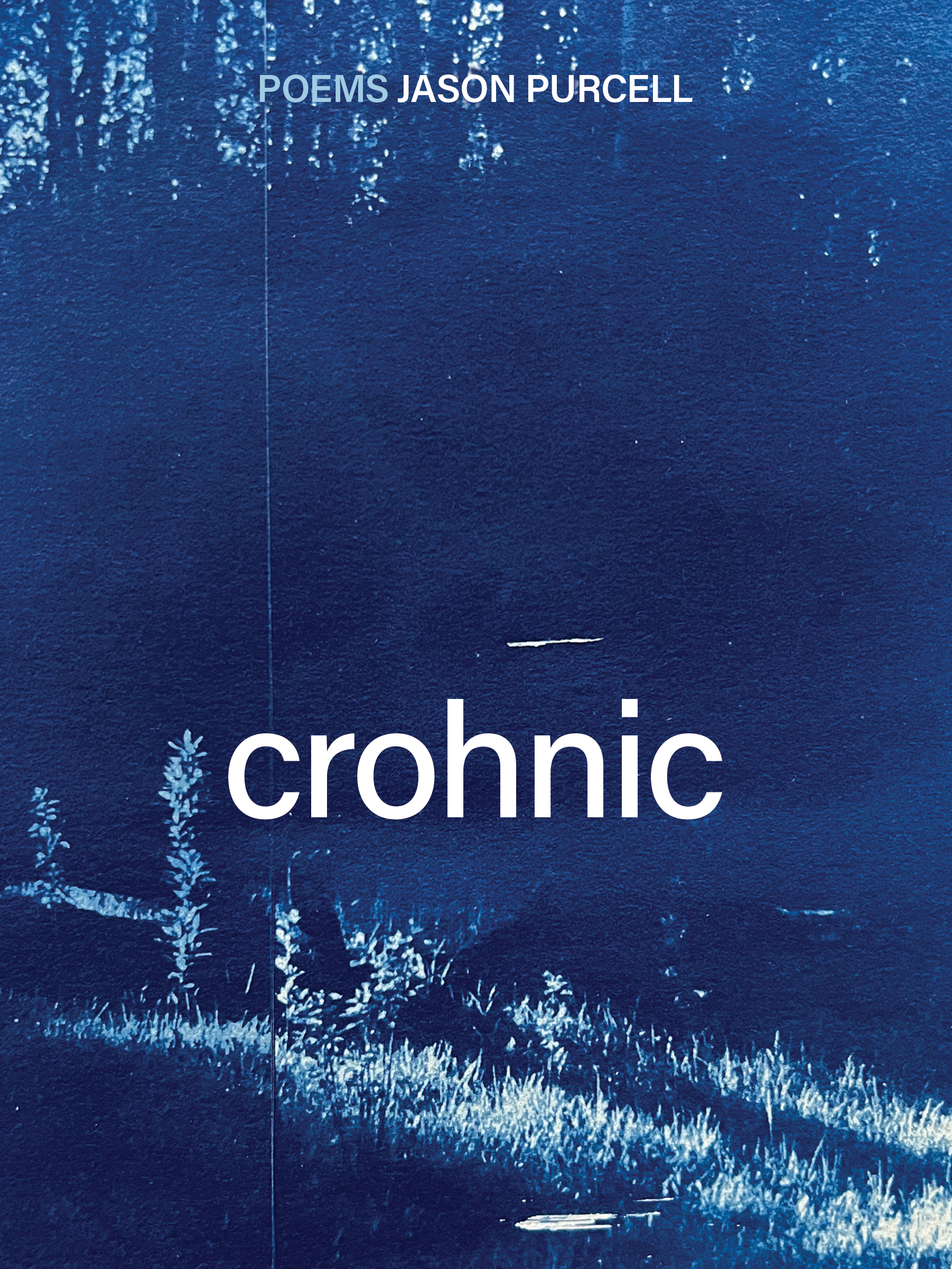
Crohnic
by Jason Purcell
Arsenal Pulp Press
104 pages
$20
In Jason Purcell’s sophomore poetry collection, Crohnic, we are invited into an intimate exploration of the author’s treatment for Crohn’s disease (reflected in the collection’s clever title), alongside reflections on the simultaneity of life and decay, the queering of the natural world, and what it means to contend with illness. Read in the wake of Purcell’s debut collection, Swollening (2022), this new work builds on their earlier poetic narratives of queering disability and illness. With its stream-of-consciousness style, Crohnic also queers poetry as a genre: as readers, it feels as though we are travelling alongside Purcell in this journey, through each IV drip and each melting bank of snow.
From the very beginning of the collection, this approach is evident. Purcell writes, “Winter / puts us to sleep so we can be reborn. I take my prescribed and measured / harms so that I can live more fully. The river flows, sheets over, changes / states, and then.” These lines are a profound distilling of the themes Purcell highlights in this book. This is not a collection merely about the seasons, or disability, or nature: it is about multiplicity, hope, reciprocity, and the profound nature of the human experience.
This collection itself feels like an open hand, as if Purcell’s poetic thoughts are extended to the reader as an offering. The author writes, “Two hours after meals I swallow down the antibiotic that works by arresting the repair and replication of the bacteria inside me. Everything collapses from the inside.”
Within more narratively heavy sections of the book, the immediately retracting scope with which Purcell contemplates—from the minutia of bacteria to transcendental explanations—creates the sensation of going beyond the poem and into the poet’s inner monologue. The result is a sobering and beautiful collection that holds pockets of wisdom about seasons of life and all the different ways that we choose to survive.
By the end of the collection, we feel as though we have lived through a season alongside Purcell, and arrived at the realization that we, too, have survived the winter. One of the last lines in the book is, “I have stayed quiet, lulled by this drip, this drip of spring, melt as medicine.” Illness is complex and non-linear, and Purcell’s willingness to allow us into their experience and subsequent reflections during a period of vulnerability and uncertainty feels like a deeply generous offering. I look forward to future seasons of Purcell’s works.