These existential crises, these states of emergency. What are we to make of, or in, them?
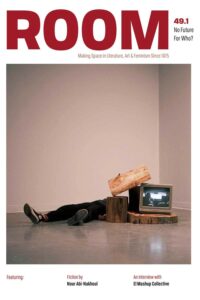
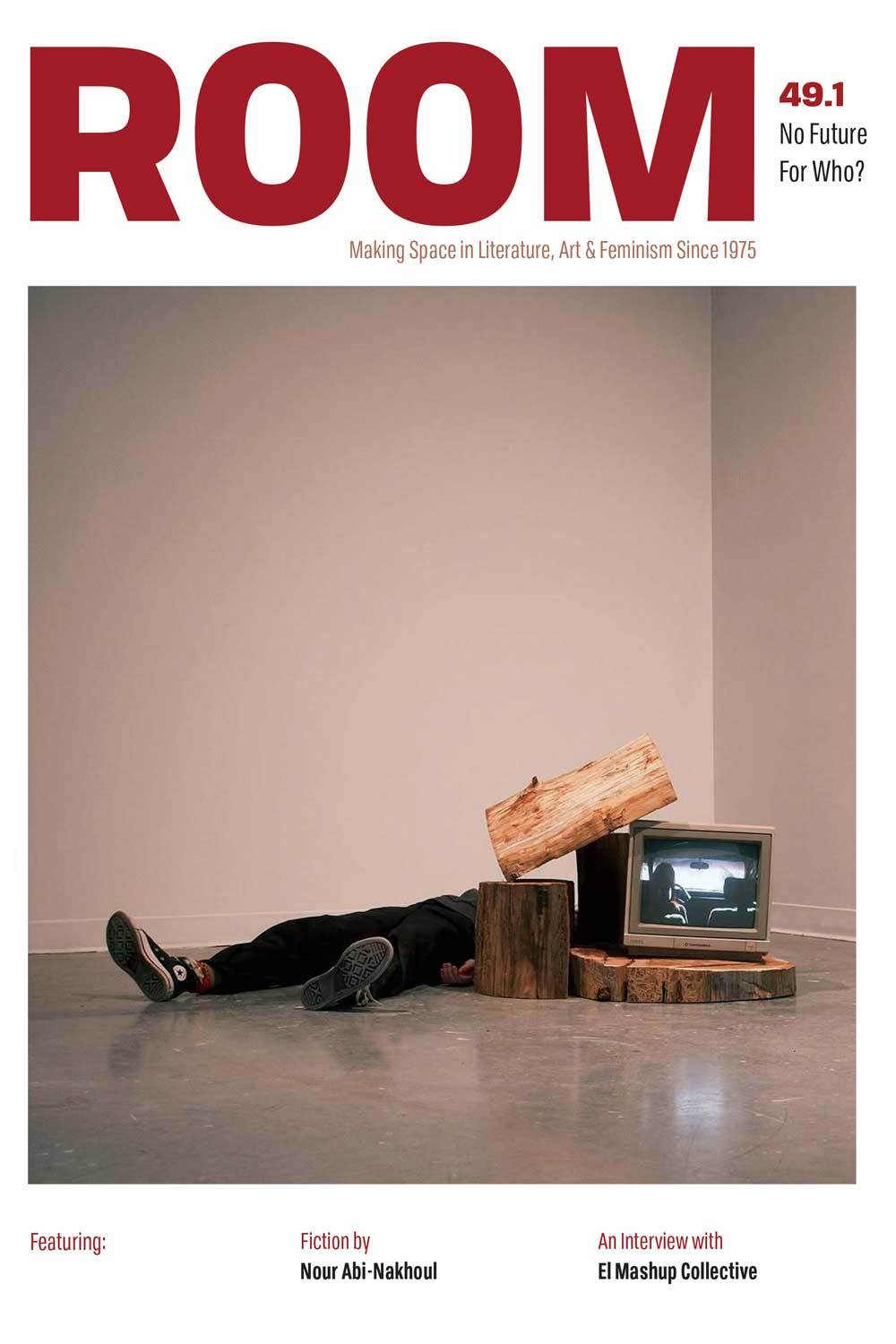
Today, we’re sitting with a fiction piece by K.Y. Agbayani from our current issue Room 49.1 No Future For Who?.
“Lilah Around Town”
by K.Y. Agbayani
The air was dusty after the funeral but we sat on the porch anyway, well into the evening, sipping on amber bottles of malt from the neighbours’ garage fridge. When the neighbours discovered their malt missing, we ran into the house, giggling, the screen door slapping into the frame. That whole summer smelled of warm rust.
It was odd to have the funeral without the body, but Lilah was missing for two years and Auntie Lo had to call it. Enough was enough. The school pooled money together for the funeral, put a notice in the monthly flyer, and I had to give a five-dollar bill in a Ziplock bag to Mrs. Bernstein even though Lilah was my cousin and Auntie Lo watched me and Jericho and Jennifer after school while our parents were working late. We all sat at the dinner table that evening, counting the bills and putting them in neat, colourful piles.
But the funeral was what we expected. Jennifer brought playing cards and taught Jericho and me War in the back room of the parlour. When it was time to go out, my mother tied the customary white ribbons around our heads and led us to our seats out front. There was no casket, but there were flowers and a blown-up picture of Lilah looking bored at the zoo, wearing my purple Bratz T-shirt. It was the same picture they had used in the missing posters which were still all over town, sun-bleached and covered over with staples. You would think that we’d use a couple different ones for the service. I suspected that we only had the one. Jennifer, oldest, made up the bulk of the family photos. Of Jericho and me, the last to come along, there were almost none. None at all, after. I know because I looked.
When we were teenagers, no longer yoked to Auntie Lo’s basement apartment after school, the local paper wanted to write a story on Lilah. A ten-year anniversary piece that, the reporter convinced Auntie Lo, might resonate with someone who had details on the disappearance and inspire them to come forward. Forward with what? I thought at the time. Whatever happened could not be reversed. I had an algebra test to study for, and finishing freshman year with straight As would do more to alter the course of my future than reminiscing about my cousin.
When I said that to my mother, she smacked me across the mouth—open-palmed so I knew she didn’t mean it. The interview was set up in the park behind our bungalow. They wanted pictures. Jennifer and Jericho would join me.
Alan had an Eastern European last name I couldn’t pronounce so he was simply Alan the journalist. Alan had a high, smooth forehead and earnest eyes. He looked like a weary principal. He recorded us on his phone and took notes on a simple legal pad. Jennifer had just turned eighteen, pretty in a baby-faced way and recently accepted into business management school. Jericho was just starting to accumulate the grime of a teenage boy—a can of dip in his cargo shorts that I knew he didn’t know how to use.
“I can’t imagine how painful it may be for you all to recount that period in your lives,” Alan said. He seemed to look all three of us in the eye at once. “And I know you were only children at the time. So let’s start off simply: what’s your favourite memory of Lilah?”
I looked to Jennifer and Jericho, who looked to me. I shrugged. “She didn’t get into trouble. She was fine.”
Alan wrote approximately one word. He looked encouragingly at Jericho, who said, “She didn’t eat a lot. I thought that was weird because I was always so hungry, but she just wasn’t like that.”
“Is there a specific moment you could point to?”
“How can I remember someone not doing something?”
“She liked to have her hair braided,” Jennifer offered. “She had lovely hair.”
Alan underlined something on his notepad. “It’s my understanding that you all were raised together. Would you say that you had present parent figures at the time—that you had someone looking out for you?”
“We were taken care of,” I said curtly. It was late afternoon on a Sunday. It must have been Easter—late spring and nobody in the park.
“Of course,” Alan said. “I meant, were there any odd figures in your life?”
“We already told the police there were no strangers around,” Jennifer said. “It was the way it always was.”
Alan tugged lightly on the ends of his trim beard. “Understood. Let’s get back to Lilah.”
Lilah before, never after. Lilah on the swings, smacking her feet on the ground to soften her backwards ascent. Lilah never looking you in the eye. Jericho was wrong—rice crackers. The colour yellow. I had to close my eyes. I could remember but that didn’t make it love. Didn’t make it anything you could count on.
“What would you want the public to know about Lilah?” Alan asked.
Jericho reached into his mouth to touch the gums along his bottom-left molars.
“Why would they even need that?” Jennifer asked, pulling Jericho’s hand away without looking.
“People like to feel . . . connected,” Alan said. “And it’s a beautiful sentiment, isn’t it, to be connected to someone you never met?”
I smiled pityingly. “Do you feel beautiful right now?”
He paused the recording, tapped his phone. “How about pictures?”
Jennifer insisted that none of our faces be shown, so she arranged us—to Alan’s simmering displeasure—facing toward the park playground with Alan shooting us from behind. We just stood there, not touching. Alan suggested that Jennifer stand in the middle and put her arms around our shoulders. Jennifer said that it would make her look like a teen mom.
In the photo that was actually published, Jericho was sitting in the grass, leaning against my legs. Jennifer picked dandelion fluff from the ends of my hair. It was a lovely picture. My mother cut it from the newspaper and propped it against Jennifer’s framed graduation photo. The article recapped Lilah’s disappearance, the fruitless investigation, and what it means when we let our most vulnerable members of society fall through the cracks. Who bears this responsibility and who pays the price. We were quoted calling Lilah “lovely” and “selfless” and “cared for.”
I used my mother’s email to contact Alan. I invited him back to the park, using my mother’s name. Something about discussing a follow-up article. When he recognized me at the park bench, he paused before lumbering over.
“Your mother doesn’t know about this?”
“Probably not.”
“I don’t think this is a good idea.”
He stayed where he was. By this time, it was summer, the cicadas buzzing gleefully in the straw-like grass. It hadn’t rained for weeks and we were well past gratitude for the good weather, even the children, who had grown lethargic in this dizzying stretch of sun.
“How did you like the article?” he asked finally.
“It was like it was written about someone else.”
“It was fact-checked.”
“Do you write about this stuff all the time?”
“I’m on the local lifestyle beat,” he explained. “Local, close-to-community stories about real people living in these neighbourhoods.”
“Do you live here?”
He hesitated. “Sometimes, but mostly not.”
I nodded. It was the first time he made sense to me.
“I’m sorry if it upset you. The whole process.”
“I’m not upset.”
“You weren’t very forthcoming.”
I hummed under my breath. “I know it’s just your job, but it isn’t mine.”
“Fair enough.”
“Where did you find those other photos of Lilah?”
He shrugged. “I had to dig a bit. Friends of family and family of friends.”
Lilah shrinking in the first row of a class picture. Lilah at a birthday party—pink tights. Relief came all at once like a spring deferred. That she was real, that her life—like everyone else’s—went on even when I couldn’t see it. That it still might—although it was too late for all that.
“What do you do with the gaps?” I asked.
“Of a story?”
“Yes.”
“We acknowledge them. We move on to what we do know.”
How do you prove it? was the truer question. I could never begin to look at it straight on: remembering something that didn’t happen, or happened wrong, or happened sideways. It happened to the wrong house. He walked into the wrong bedroom. Even the light was crooked. Even the weather that day was wrong, was the first cold day of the summer, was only July, and the long, looping daylight was supposed to protect us.
“Well, did it happen?” he asked.
I didn’t remember saying anything out loud. “Yes, in a way,” I replied.
“What kind of way?”
“I don’t know. Almost.”
“Almost doesn’t count as happened.”
“Even when you feel it? Just behind your eye?”
He patted my head and then stopped, his hand hovering awkwardly in the air before settling on his knee. “I think you’re being ridiculous, but probably not.” I nodded. This too made sense to me. There was nothing left to say.
He stretched his hand out. I stood still, refusing. He offered one last close-lipped smile before walking off. I watched him leave, letting go of my held breath once he finally disappeared from view. There were things I wanted in life that I couldn’t get, and now it felt good to refuse.
I started for home. I tried to remember the last time someone touched me like that. I took the long way, thinking about the weight on my head, trying to remember anything before or after.
Pre-order Room 49.1 No Future For Who? now.